Friday, August 09, 2013

Quicksand - Spectral Reflections - Dizzy

Lately, Frank Gratkowski has been on the playlist. I find myself listening to his music in blocks - spend a week or two listening to a few of his albums and then take a break.

First up is his trio disc Quicksand (Miniscus 1999) Gratkowski (as/clr/b.clr) George Graewe (p) Paul Lovens (d/singing saw).
I bought this album late last year and it had been a good four or five months since I had last listened to it.
I am always amazed by the variety of sounds Frank can bring out of his horns, but usually the thing I enjoy most is his line playing - "Green Fuse"  has some nice alto lines with Graewe's piano playing likewise and Loven's drums interjecting and implying various pulses.
The energy is ramped up until the lines lead to breaking point. Things drop down with piano and drums moving into a lengthy duet with clarinet joining them in to round out the piece. The playing and interaction throughout the set is on a high level. For the most part this is fairly high energy free improvisation, but there is enough variety to keep things interesting. The music breathes and is nicely paced. Very nice sounding live recording too.
I find the length of the album refreshing - 44 minutes.

Frank Gratkowski Quartet - Spectral Reflections (Leo 2001)
Gratkowski (as/clr/contrabass clr) Wolter Wierbos (trb) Gerry Hemingway (d) Dieter Manderscheid (b)
The quartet covers a lot of ground over the six tracks - Abstraction ("Blonk"), Swing ("Annaherungem III"), Ballad ("Fenster"), Rhythmic intensity & full throttle blowing ("Loom"), Mysteriousness ("Spectral Reflections"). "Homage" combines many of the above - starting as a haunting ballad with arco bass and angular clarinet, adding vocalized sounds from trombone and minimalist textural playing from drums that gradually become more rhythmic. The trombone and clarinet move into a pointed dialogue with sparse accompaniment that gradually builds into full on swing from the rhythm section while the horns team up and dance on top. They then get a bit a solo space - with some particularly potent clarinet playing - before things drop back down and the piece wraps up with trombone and clarinet. I have heard a fair bit from the individuals in this group but haven't heard much of this quartet - time that changed I say. I would like to hear in concert.
Last December, Leo Records released a new album from the quartet - "La Vent Et La Gorge" I am yet to hear it.

Dizzy Gillespie's early years have had bit of a run over the last few days.
His first solo on record - "King Porter Stomp" from 1937 with the Teddy Hill Orchestra. "Pickin' The Cabbage" from 1940 with Cab Calloway & His Orchestra - was this his first recorded composition?
Coleman Hawkins 1944 recording of Gillespie's "Woody 'n' You" with Dizzy alongside other key players of the new music... Oscar Pettiford (b) and Max Roach (d).
"Blowing The Blues Away" from 1945 as part of Billy Eckstine's Big Band - Dizzy follows some extensive trading between the tenors of Dexter Gordon and Gene Ammons.
Then it was on to some his early work as a leader - sextet sessions from 1945 including "Groovin' High" & "Blue 'n' Boogie" (this was the first Dexter Gordon recording I heard) and the session from a couple of weeks later (this time with Charlie Parker) "Dizzy Atmosphere" & "Groovin' High." 

Town Hall, NYC, June 22 1945 (Uptown 2005)
Charlie Parker (as) Dizzy Gillespie (trpt) Al Haig (p) Curly Russell (b) Max Roach (d) Sid Catlett (d)... sits in on the last couple of tunes (a great contrast between the drum generations) Don Byas (ts)... fills in during the first tune until Bird arrives to much applause from the audience (seems he was gaining a loyal following).
A historically important and great sounding live recording - burning through classic repertoire - "Bebop", "A Night In Tunisia", "Groovin' High", "Salt Peanuts", "Hot House."
Each time I listen to this album I always ask "Why haven't I listened to this more?" If you haven't already, be sure to check it out.

The announcements from Symphony Sid Torin are cringe worthy, though they do fill in a few details and give some context to the time.
Diz and Bird played appeared at the Town Hall the previous month - is there another discovery for fans in the future?

I finished things off with some of classics from Dizzy's Big Band - "Manteca" and George Russell's  "Cubano Be" & "Cubano Bop." 

Saturday, August 03, 2013

listenings from the past week

Nils Wogram's Root 70 - Getting Rooted (Enja 2003) Wogram (trb) Hayden Chisholm (as/b.clar) Matt Penman (b) Jochen Rueckert (d)
The Root 70 albums are regulars on my listening rotation. Great group sound - a very distinctive ensemble. They have a new album due out this year - "Root 70 with Strings."

Dejan Terzic - Melanoia (Enja 2013) Terzic (d/perc) Hayden Chisholm (as) Ronny Graupe (g) Achim Kaufmann (p)
This one is new to me and it's only had one and a bit listens so far. Very intricate melodies with the sax, guitar & piano often each playing interweaving lines, lots of ostinato in the accompaniment - first impressions have me feeling that things are over composed. But this one needs more listens. Saxophonists, it's worthwhile taking note of the effortlessness of Hayden's playing (here, and on the album above).

Kaufmann's name in the line up above led me to Palaë (Leo 2007) by the trio of Kaufmann (p) Wilbert de Joode (b) Frank Gratkowski (as/clarinets). Seven free improvisations recorded during 2006. Often the trio sounds like a contemporary classical group (If you are searching for straight ahead, deep swing look elsewhere). I'm not a huge fan of prepared piano but Kaufmann uses it pretty well here without overdoing things. All three players have a large and varied palate to contribute to the group sound - Gratkowski brings out all kinds of sonic possibilities from his horns (alto sax, clari, bass clari & contrabass clari) - an amazing player. The trio's many subtleties are captured nicely on a well recorded album. I heard this group at Roulette during 2009 (possibly got the album at the gig) not long after meeting Frank in Greece. Palaë is the 3rd album (of 4) from the trio - I would like to hear the others.

Count Basie - The Atomic Mr Basie (Roulette 1958)
This one seemed like the perfect accompaniment for cleaning the kitchen - time flew by. I can't remember the last time I listened to this album. It made a nice contrast to the odd time signatures/micro-tonality/free improvisation etc of the above albums too.


Friday, July 26, 2013

Brötzmann : Hideout


Wednesday night I got over to The Hideout for Umbrella Music's Immediate Sound Series.

I was expecting a big turnout as the night's two sets were by the trio of Peter Brötzmann (as,ts, clar, táragató) Jason Adasiewicz (vibraphone) Hamid Drake (drums, perc). 

Having missed Brötzmann's last appearance in Chicago (I was out of town) I decided to get there nice and early. I'm glad I did as it didn't take long for the house to fill. Great to see people getting out to hear improvised music - the biggest crowd I have seen at The Hideout. It's a nice venue, plenty of character, some nice beers, good sound and sight lines, and a cozy feel.
The first set had Brötzmann switching between alto sax, clarinet and táragató. For the second he was on tenor sax. While he far from my favorite saxophonist, Brötzmann is someone I have wanted to hear in person. At 72 years of age he is still blows up a sonic storm - an avalanche of sound that must make some want to cower in the corner. The music does ebb and flow but for the most part, energy levels remained high across the two sets. Just when you think he has reached breaking point somehow he pushes through the barrier. At times I felt this got a little predictable - climbing the ladder of high and loud - but fascinating nonetheless. There is an intent to the way he starts and finishes notes/sounds - an intense focus. While there is a definite physicality to his playing, there are times when he appears to be surprisingly relaxed while playing in a manner that would cause many other saxophonists to look as though they are about to explode (perhaps it's hidden by the facial hair?). I wonder if Adolphe Sax envisioned Brötzmann's approach when inventing this wonderfully flexible instrument 167 years ago?

Nice turnout at The Hidout
Adasiewicz's playing - particularly his work accompanying the horn - really stood out. A creative player well worth checking out if you haven't already. I have heard him a number of times around Chicago and he is often the stand out player. Of his recorded work I am only familiar with "Spacer" a fine album with his trio Sun Rooms. Adasiewicz and Drake locked in well together - a duo concert/album from these two would be great to hear.

The funk/soul/disco tracks playing before the set and during the break made quite a contrast to what everyone came to hear.

Brötzmann and Drake return to The Hideout next Wednesday when they will play with Ken Vandermark (reeds) and Chad Taylor (drums).
Brötzmann's latest artworks are in town too. Left / Right opens at Corbett vs Dempsey on Saturday 27 July and runs through to August 17.

Catalytic-Sound is the place to find many of  Brötzmann's recordings. 

Wednesday, July 24, 2013

There's no there there


A few years back, Mike Nock performed a solo concert at the Illot Theatre in Wellington. The day of the concert he presented a masterclass. The turnout wasn't huge - mostly a bunch of music students alongside my friend Char Ford and I (front-row-center… jazz nerds!). Mike played a standard and a free improvisation - for the most part he talked about playing, his conception and philosophy. There aren't many details I can remember but one gem remains. When speaking about the journey of music and seeking a destination, a level to attain etc. Mike pointed out that….
"When you get there, you realize there's no there, there."

At the end of the masterclass Norman Meehan asked me if I was coming to the concert that night. I replied that I would love to but I couldn't afford it (the concert wasn't that expensive I was broke at the time). Norman proposed that if I wanted to sell CDs during the set break and after the gig then there would be a ticket for me. I jumped at the chance (Thanks Norm!). The CDs sold well. Of the half a dozen or so discs for sale only one didn't sell out…. the one without Nock playing on it (Michael Houston playing Nock compositions). It was great chatting with Mike after the gig, talking about watching him on TV when I was getting into jazz and what an inspiration he was. 

As a young musician Mike Nock was the only New Zealand jazz musician that I was really aware of. I had seen him on TV (possibly on the news) but never heard his music until later in my teens - towards the end of high school. In fact, I believe the first time I heard his music (outside of that brief TV appearance) was in person thanks to the generosity of a former saxophone teacher (thanks Brian!).

Brian had an extra ticket for a Mike Nock concert in Wellington - if I wanted to go it was mine. The concert launched the 1998 Wellington Jazz Festival. The Wellington Jazz Collective had commissioned Nock to compose a piece for large ensemble. My memories are somewhat hazy when it comes to specifics but the concert most definitely made an impact. Until then the live jazz that I had exposed to was pretty much Big Bands, Dixieland/Swing groups, and the odd group or two playing standards - this was some thing else. Nock presented his composition "Shifting Goalposts" with an ensemble of many of Wellington's (and NZ's) top musicians. I think the lineup was Nock (p) Scott Towers & Jeff Henderson (sax) Nick van Dijk (trb) Chris O'Connor & Roger Sellers (d) John Bell (vibes) Paul Dyne (and someone else… Patrick Bleaky or Tom Callwood) (b).... it was a nine or ten piece group. Please let me know if my memory has failed me. Over the following three years many of them would be my teachers at music school.

If there is a recording of this concert floating around I would love to hear it.

Wellington Public Library has treated me well over the years. As a teenager I would browse the racks finding things to listen to - artists I had read about or just random albums. Around the time of "Shifting Goalposts" one such visit lead me to Ondas (ECM 1982 - with Eddie Gomez (d) Jon Christensen (d)). At the time I was listening to lots of Bird and getting into classics like Sonny Rollins (Saxophone Colossus) Paul Desmond (Time Out) Ornette Coleman (Shape of Jazz) Dexter Gordon (Our Man in Paris) - Ondas was quite a change for me. 
The mood is quite reflective throughout the album (things pick up tempo-wise on "Doors"). The drums sneak in and out while the bass accompaniment is sparse. Nock's piano is light with crystal clear purpose. I'm surprised this is the only work Nock did for ECM.
Check out Nock's album In Out and Around for an earlier quartet version of "Forgotten Love."

During the 1990's Nock worked as a producer for Naxos and the label priced its releases much lower than was common in New Zealand - that, and they had distribution in NZ, meant these are the albums I have heard the most.

Ozboppin' (Naxos 1998) got many spins when Char and I were working at Piano City. Fine playing from what I believe was Nock's working group of the time - Tim Hopkins (ts) Phil Slater (trpt/flugel) Cameron Undy (b) David Goodman (d) It had been a while since I last listened to the entire album - Nock's solo on the title track always stood out to me.

Not We But One (Naxos 1997) Tony Reedus (d) Anthony Cox (b). Nice interplay from the trio on seven compositions from Nock, three free improvisations and one standard ('Cry Me A River' in 3/4). An album with nice amounts of variety yet plenty of continuity. I would like to hear some of his more recent trios - I haven't got to 'Changing Seasons" & "Accumulation of Subtleties" just yet.

The Waiting Game (Naxos 1999) A set of duos with Marty Ehrlich. Once again there's plenty of variety with the material - Five Nock originals, free improvisations, folk tunes, and one piece each from Brubeck & James P. Johnson. This disc was introduction to Ehrlich's playing who divides time been clarinet (soprano & bass) and saxophone (alto & soprano). It's a nice pairing, with two distinctive sounds with plenty of common ground. For more of Ehrlich & Nock together check out the two New York Jazz Collective albums (also on Naxos). 

Duologue (Birdland 2007) duo with David Liebman (soprano sax). I picked this album up a couple of years before getting into soprano. The recording captures the warmth of this duo in concert at the 2004 Wangaratta Jazz Festival. Two old friends sharing the bandstand after many years apart seems to bring out the best of both artists. The set list includes originals by Nock & Liebman plus a couple of standards. Liebman has some long standing relationships with pianists - Richie Beirach, Phil Markowitz & Marc Copland. Duologue makes me want to hear some follow up work between these two. Back in the 80's they did record as part of a quartet (The Opal Heart) but I am yet to hear that disc (I see it's on Spotify). This disc backs up my feeling that the soprano saxophone is Liebman's voice. Mike's accompaniment & solo work throughout is top notch. 

While I'm on the subject of duos I don't want to leave out Open Door (Ode 1987) with drummer Frank Gibson Jr. The groove of "Harriet St" & "Phaedra's Lullaby", the harmonies of "Danny Boy", the up-tempo "Choices" and the journey of "Great Wall." This one has had plenty of plays over the years too.
Nock's most recent release - Kindred - another piano/drum duet, this time with Laurenz Pike. I look forward to hearing it.

For those of you after more info on "the white boy from Ngaruawahia" be sure to check out Serious Fun: The Life & Music of Mike Nock by Norman Meehan(Victoria University Press 2010) 

It's full of wonderful tales from his early years in New Zealand and relocating to the USA (via Australia) - touring with Yusef Lateef and Stanley Turrentine, the NYC lower east side scene during the 60's, The Fourth Way etc - through to his mentoring of younger players in Australia. 
Here's a couple excerpts from the book: First up - Nock on fellow pianist Paul Bley. 

"It didn't matter what the changes were - sometimes he might refer to them, but a lot of the time he wouldn't at all - and it didn't matter. It's the strength of the line that carries it. Playing with total certainty about you are doing is what makes the difference." 

And, from the final couple of pages:
"Jazz is serious - it's serious fun, but for me it is serious music - otherwise what's the point in doing it? Mediocrity doesn't rule my life."

An added bonus included with the book is the DVD - Mike Nock: A Film. I have blurry memories of watching Nock on T.V before I started playing sax so I'm guessing it was documentary (it seemed very familiar when I watched after reading the book).

I am yet to delve into his music from a playing side. Perhaps that awaits me in the future.

Saturday, July 20, 2013

Notebook 1: Old Music New Music

On and off I keep a notebook of thoughts on music and saxophone playing. Earlier this week I flicked through the pages of one that is about a year old and decided to start posting some of my pre-blog ramblings.
=== == === == === == === == === == === == === == === == === == === == === == === == === ==

* Don't Be Afraid Of Old Music * * Don't Be Afraid Of New Music *

About 12 years ago I asked a pianist friend of mine who they were listening to - Bill Evans, Keith Jarrett, Brad Mehldau were the answers.  I followed up by asking if they listen to any pianists from earlier in the jazz lineage - "Not really" they replied.  Why not? They figured their favorite players were influenced by the earlier masters and that influence would be passed on to them.  Plus they didn't like the sound of old recordings!
One of the most in demand players in town and they had never checked out the likes of Art Tatum, Erroll Garner, Teddy Wilson, Duke Ellington, Bud Powell.  I was very surprised. Perhaps Teddy Wilson could have opened some new avenues to explore that weren't apparent in the music of Keith Jarrett.
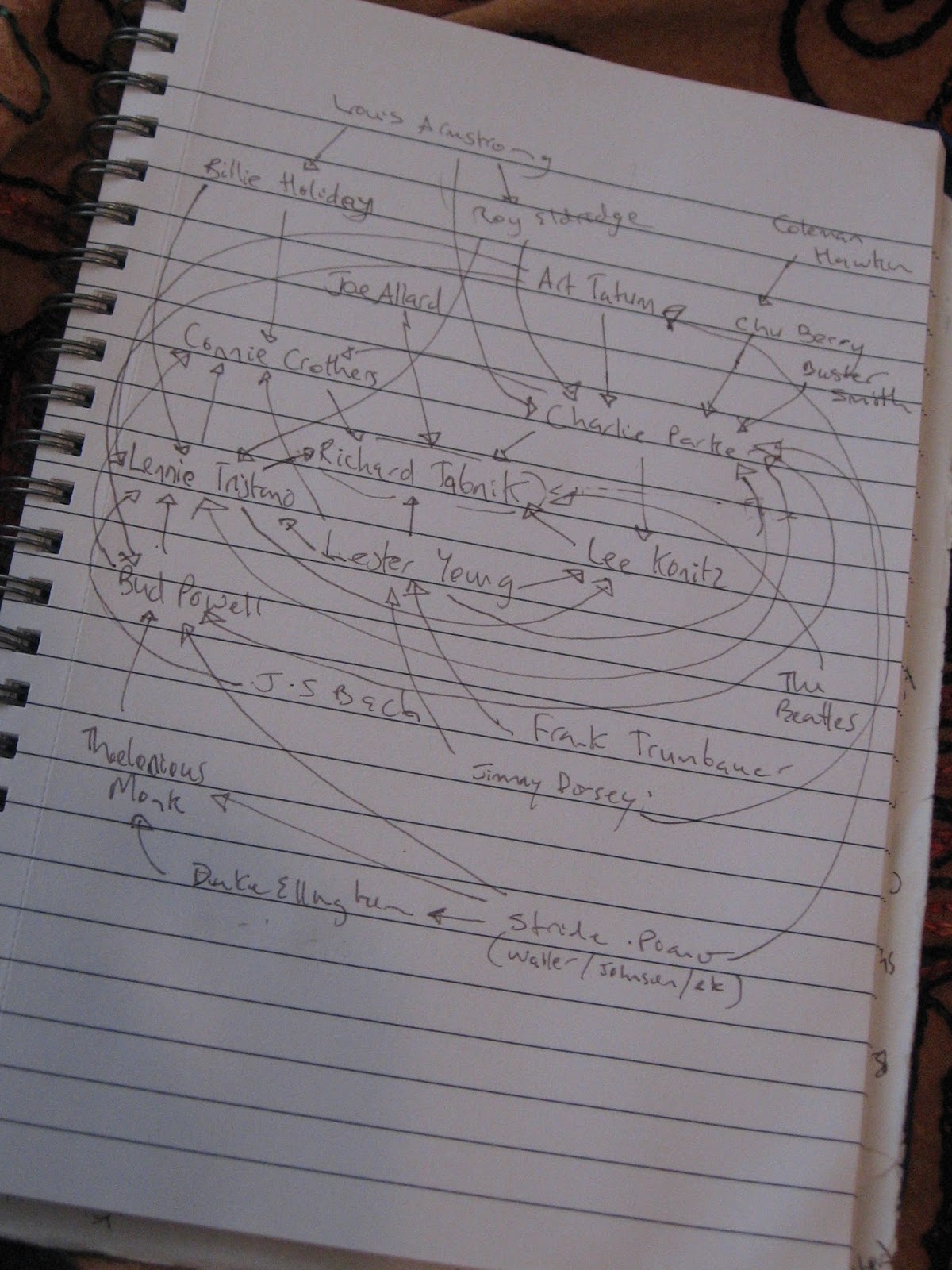
I have always loved going back and listening to those who influenced my favorite artists.  Here's a page from the notebook (click on it to enlarge) where I've plotted players around saxophonist Richard Tabnik - it doesn't take long for the web to expand (and it is by no means complete). Some of these artists I am quite familiar with, others less so but I have listened to them all.

What's new to you may be contemporary, from another era, underground or mainstream.  It may be old to others.

In 2009 I attended over 100 gigs during a six month stay in NYC - lots of great music, plus plenty that did nothing for me - It's good to find out what you don't like! Why don't you like it? Revisit it - tastes change.  I first heard Evan Parker in concert. It was intriguing so I had a listen to a couple of recordings and didn't like them at all (these were full-throttle type things). I shelved him. Then a couple of years ago, I spotted an album (Time Will Tell) and gave it a shot - this time I quite enjoyed it. Whilst I can't say I enjoy all of his vast discography there are a few nice ones in there for me (they tend to be at his mellower end).

The Music Village workshop in Greece opened my ears to a lot of new music - Alexander Berne, Morton Feldman, Kaum Quartet, Fo[u]r Alto, Stockhausen among others. Working on Stockhausen was another new challenge and I took those pieces with me (they are still a challenge). Frank Gratkowski's composition for 14 Alto saxes playing multiphonics was not like anything I had been part of before. It was very exciting playing this music to a crowd of people that arrived not knowing what to expect and left having been part of a great night.
---------------------------------------------------------------------------------------------
This page has been a nice reminder to give Chu Berry a spin.... Sittin' In, Chuberry Jam, Limehouse Blues, Monday At Minton's, Blowing Up A Breeze, Body & Soul have been playing as I type. NICE!
---------------------------------------------------------------------------------------------

Monday, July 15, 2013

Rob Mazurek Solo

Saturday afternoon I headed over to Corbett vs Dempsey for a solo concert by Rob Mazurek.
About 40 or so people turned out on a beautiful Chicago afternoon. I'm not that familiar with Mazurek's work so I approached this performance with a pretty clean slate.

The set was one long piece/suite of solo Cornet, Percussion, Electronics, and Voice. If I were to hear any of the movements in isolation I probably wouldn't have thought much of it. But joined together they created a work that unfolded wonderfully.  

Starting with a single pitch repeated, moving through blurs and splattering from cornet interspersed with percussion (mostly in the form of various shakers) an interlude on wooden flute, building to a wall of sound courtesy of swelling electronics, cornet, and eventually a giant shaker, cutting off to end with the breath of Mazurek. 

As an improviser I took away a couple of things in particular. 
Dynamics - From a whisper to a roar. Sudden changes as well as crescendo/decrescendo.
Space - Silence was embraced, especially early on and between movements. It was very much part of the performance.
Pacing - The performance was not rushed.
Texture/Density - As the wall of sound grew denser the cornet playing simplified, a nice contrast.  

In a couple of weeks CvD will be exhibiting works by Peter Brotzmann - I must add that to the calendar.

Sunday, July 14, 2013

straight ahead

I've spent this week at the Jazz Institute of Chicago's Straight Ahead Jazz Camp. A weeklong series of workshops aimed at jazz educators. I also attended Straight Ahead in 2011. The theme for 2013 was The Legacy of Louis Armstrong.
Here's a little of what went on throughout the week:

Ricky Riccardi
Ricky Riccardi, author of "What A Wonderful World" and chief archivist at Louis Armstrong House, made too Armstrong presentations on Day 1.
In His Own Words - snippets from Armstrong's private recordings (he made over 750 reel to reel tapes). An amazing insight into his private life. Recordings from home and on the road... talking to friends, listening to music, reading the newspaper, reading letters, arguing with his wife!

Cinematic Satch - rare video footage from the archives. A great chance to hear and see things that may never be released.


Dana Hall Modern Pathways: Exploring the multi-dimensional music of Andrew Hill. 
My knowledge of Hill's music is fairly limited (Point of Departure, Time Lines, Black Fire and a few other bits and pieces) and I felt this was a great presentation. Knowledgable, enthusiastic, warm, not too formal or technical but clear with a nice mix of talking, discussion and listening. 

The Collective Improvisation ensemble class was directed by Mwata Bowden.
Mwata brings great energy and passion to the music. He had his work cut out.... 2 flutes, 7 Saxes, 3 Trombones, 1 Tuba, 4 Trumpets, 5 Guitars, 2 Drummers, 6 Pianists, and about 6 vocalists on stage together. It was a fun session running through Fletcher Henderson's "Jangled Nerves" and  Louis Armstrong's "Struttin' With Some BBQ." 
After School Matters Big Band
Back at home I had a listen to the Henderson band of 1936 take on "Jangled Nerves" - features some nice Chu Berry and Roy Eldridge and tight ensembles.

Wednesday we had lunch at Buddy Guy's Legends while listening to the After School Matters Gallery 37 Big Band. Over the summer break the band, made up of high school students, rehearses daily in Millennium Park.

Guitarist Mike Allemana is currently working towards his PhD - Von Freeman being the topic of his study and of his presentation this week. Mike detailed his apprenticeship under Freeman - first at jam sessions, then as a member of the band (for 15 years) and how Freeman mentored younger players. The presentation was a bit dry but full of good info and some sweet stories too. This is interesting and important information and it looks like Mike will be updating his progress on his we site.

Jose Diaz ran a great session for music teachers - full of practical advice. Jose got everyone involved working on rhythm via call and response, improvising with rhythm, layering rhythms, vocalizing rhythms. Later that afternoon he ran a rehearsal with the Jazz Links Youth Ensemble - a big band made up of kids aged about 10-15 or so. Jose had the kids vocalizing the rhythms of the parts. In fairly short time the bands phrasing had made great improvement.
Noteworthy Jazz Ensemble
Finishing off the last day was the Noteworthy Jazz Ensemble - a big band comprised of Chicago public school music teachers (many of whom we attendees at workshops). First up they sight-read through a dozen new-ish released big band charts (mostly levels 1-3 mostly). 

After lunch Noteworthy performed a set of music - Spain, Bernie's Tune, Royal Garden Blues, The Duke, Come Together, Afro Blue. This set was a lot more together than some of the sight reading.


The Rambler
All in all it was an interesting week. I only found one part disappointing - the four sessions involving Wycliffe Gordon. Gordon rambled through each of the hour and a half sessions occasionally touching upon the topic of Louis Armstrong. The last session was particularly brutal - an hour spent talking about what today's youth wear..... I was struggling to see the connection to "Satchmo, A World of Education." I expected a lot more from him. 

One thing I found interesting was the focus on the late(r) period of Armstrong...… in fact the early work (I feel the most important) barely got a mention all week at the classes I went to - Mwata Bowden being the only person I recall who's focus was on the early work.