Showing posts with label Paul Bley. Show all posts

Thursday, October 03, 2024

Jazz | Pint | Bley

Norman Meehan

Tonight I’m listening to the most recent addition to my Paul Bley stash. Another recent reissue from HatHut on their Ezzthetics imprint – ‘Paul Bley Trios Play Annette Peacock Revisited’ comprised of two sessions from 1966 and 1968 featuring Mark Levinson (b) and Barry Altschul (d) and Gary Peacock (b) and Billy Elgart (d) respectively. It combines tracks from ‘Ramblin’, ‘Blood’, and ‘Mr Joy’ – all albums I don’t have so I thought, “why not?” (maybe eventually I’ll pick them up individually but this incomplete compilation will do for now). The compositions and approach from the trio – spacious, introspective, stark - is a departure from the norm at the time. Occasionally things get ramped up (“Blood”, "Kid Dynamite") but there’s a focused, quiet intensity in this music that appeals to me. Bley is never far off the rotation, so I'll no doubt "Revisited" will be revisited. Bley really set the standard for that type of approach at the piano and I’ve wondered how I could bring some of this to my saxophone playing – it’s in there somewhere, but more of than not, notes have a habit of getting in the way.

I first heard Bley on recordings by the Jimmy Giuffre trio (one of my favourite groups) and shortly after on 'Sonny Meets Hawk' courtesy of Norman Meehan, whose book ‘Time Will Tell’ I’ve been dipping in and out of over the last week or so too. It’s an entertaining read and Bley is not afraid of sharing his thoughts. I’d like to re-read Bley’s autobiography ‘Stopping Time’ (which I first read not long after hearing my introduction to his recordings) but it looks to be out of print and I haven’t managed to find a nicely priced copy.

I managed to hear Bley live once, squeezing in last minute at the Blue Note to hear him in duo with Charlie Haden (the only him I heard him too). Wasn’t the greatest seat in the house.. crammed into the bar, I could barely see either of them and it was kind of noisy (I questioned why these people even bothered going). But, I did get to hear them even if in somewhat non-ideal settings.

Accompanied on this cool spring evening by Three Boys Oyster Stout (I thought the stoneware was appropriate for the season).

Thursday, April 25, 2019

Music for Commuting: Trio = Piano + Sax + Bass

Slow FoxThe commuting continues but the posts have slowed down. Long weekend procrastination was not particularly obliging with blog updates but a couple of train rides helped scraping together something. I’m slowly catching up on things.

I played the title track from Time Will Tell to some friends earlier in the month. I’m not sure it really resonated with them, but that won’t stop me from trying to expose them to some different stuff. The follow-up, Sankt Gerold, is on my “to get” list. I'm pretty keen to hear Barre Phillips new solo album too.

I hadn’t listened to Slow Fox’s second album, Gentle Giants, all that much and I was happy reacquainting myself it on the way to work last week. It led me back to the trio’s first album, The Wood, when heading into Wellington for a couple of gigs. I was going to try and play favorites, but in the end.... why bother when you can sit back and enjoy them both. For NZ Music Month I’ll be sending a bunch of friends a playlist which will include a track from Gentle Giants.


Sunday, December 23, 2018

Music for Commuting: Paul Bley and Steve Lacy

Paul Bley Annette, Steve Lacy Morning Joy
After a few months at sea, the boxes arrived home. 
Morning Joy and Annette celebrated 
freedom, keeping me company during the commute. 


Thursday, June 07, 2018

Recent listening: Some Ornette and Bley

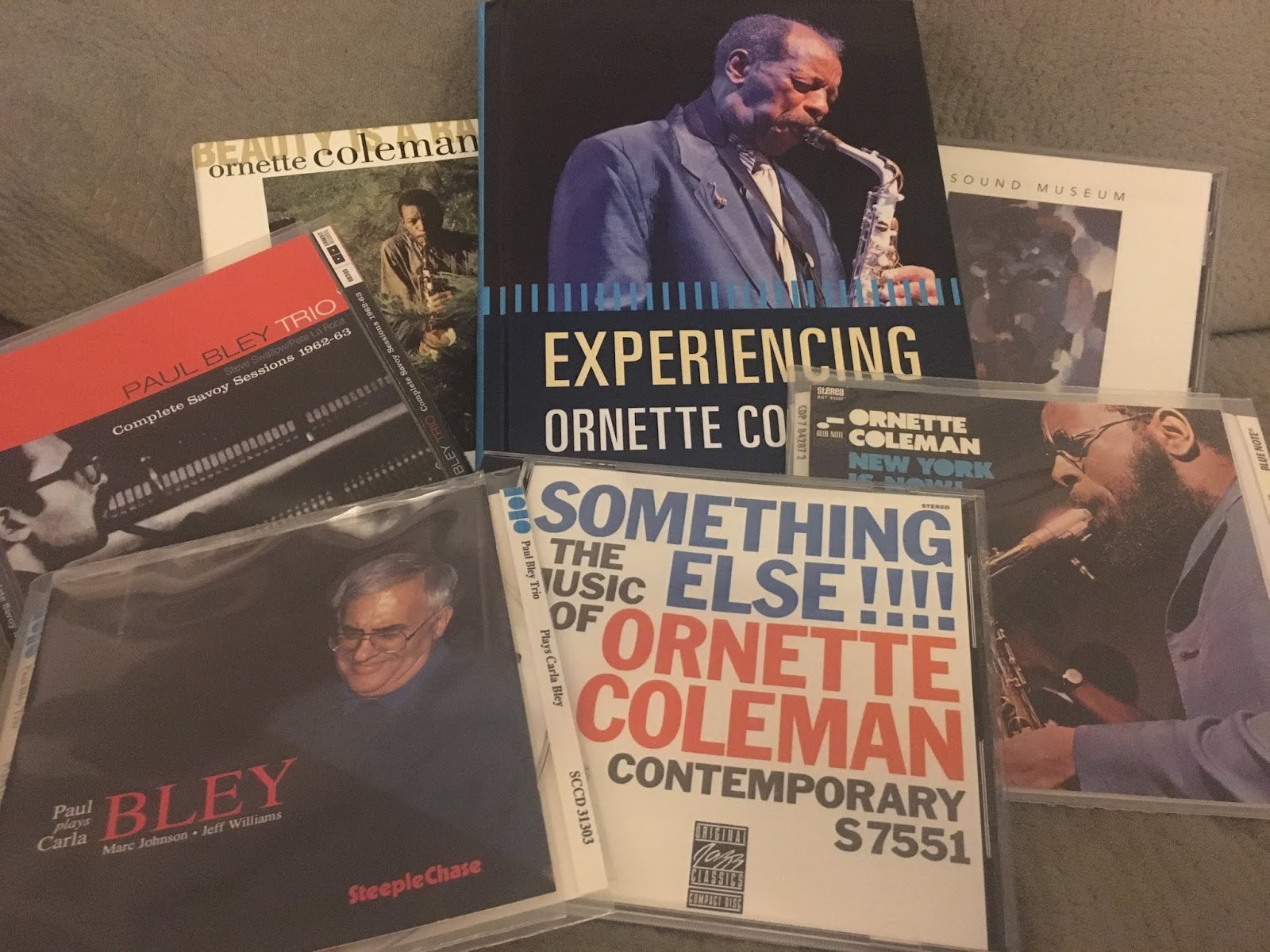
Experiencing Ornette ColemanNew Zealand Music Month had me listening to a lot of jazz from back home, although towards the end of the month I started listening to selected tracks from a bunch of Ornette Coleman albums. I've been working on the melodies of "Jayne" from Something Else!!!! and "Humpty Dumpty" from This is Our Music. "What Reason" from both of the Sound Museum albums has been getting airtime (both of these albums deserve more of my attention). Ornette on Tenor is the Atlantic album that I have listened to the least, so that has been played a few times over the past week. The hook-up between Jimmy Garrison and Ed Blackwell is superb and it made me want to hear more Garrison with Ornette - coming in the form of New York is Now! (I don't have Love Call...yet). Also tickling my fancy of late has been some Paul Bley - a player never out of rotation for very long. This time round it's been a smattering of tracks from Paul Plays Carla and the Complete Savoy Sessions 1962-63. Not pictured are Song X and Tone Dialing which is where this little blast of Ornette began after I caught myself singing "Kathleen Gray" couple of times and decided to learn it. Accompanying on the train ride to work has been Michael Stephan's Experiencing Ornette Coleman. It's a pretty easy read, not a lot of new information, but it's interesting to read another take on Ornette. I'd be interested in reading Stephen Rush's Free Jazz, Harmolodics and Ornette Coleman. And as it turns out, it's at the public library too, so that will likely be next on the list.

Saturday, November 11, 2017

Paul Bley: Being Together

Here we have Michael Cuscuna's profile of Paul Bley for the October 17, 1968 issue of Down Beat. Do yourself a favor and be sure to check out his trio recordings from this era (Footloose, Closer, Touching, Ramblin'). Most recently I have been listening to Plays Carla Bley, a 1991 trio recording for Steeplechase with Marc Johnson and Jeff Williams. 

I have some articles in the pipeline to post in March and May but for now, this brings to an end the regular postings. In the meantime you can browse the list of magazine article uploads here.
Michael Cuscuna Down Beat Magazine

Monday, April 04, 2016

Is it fitting that April Fools Day kicks off Jazz Appreciation Month?

All going to plan, I am hoping to detail this month's listening as best I can. Plans were almost foiled by a computer meltdown on Thursday - hence the delay in getting this post together. Anyway, I kicked off the start of the month with Annette (HatOLOGY). The trio of Paul Bley (p) Gary Peacock (b) and Franz Koglmann (trpt/flg) tackle tunes by Annette Peacock. I find these compositions quite intriguing and I want to do some comparison listens - Bley has recorded a number of them before and Marilyn Crispell's trio (with Gary Peacock and Paul Motian) recorded and excellent double album in the 90s devoted to Peacock's tunes. Other albums that are slated for a listen this month include Quest's Circular Dreaming, One Dark Night I Left My Silent House - the duo of Marilyn Crispell and David Rothenberg, a couple of albums I picked up at Ran Blake's concert last weekend - I'm particularly looking forward to Ghost Tones featuring George Russell compositions. Steve Swell's latest (featuring Connie Crothers) arrived in the mail last week, so add that to the list. Also, I've been working my way through Wayne Shorter's Blue Note albums and I'm up to Speak No Evil so that will get some airtime too.

Friday, September 04, 2015

More Bedside Listening

John Carter & Bobby Bradford Quartet: Flight for Four (Flying Dutchman) This album has been sitting on my "to listen to" pile and I finally got around to it. Mark Weber put me onto this quartet and I'm glad he did (Mark recently posted on John Carter here).

Sal Mosca: The Talk of the Town - Live at the Bimhaus (Sunnyside) This 2CD set of live solo piano from 1992 released earlier this year is an absolute gem. Wonderfully recorded, the album has a very intimate feel - it's almost as if you are a fly-on-the-wall in Sal's studio. Be on the lookout for more Mosca - I understand a box set is due out towards the end of the year. Hopefully these releases will bring more attention to a very underrated pianist.

Dizzy Gillespie: Perceptions (Verve) Earlier in the year I was checking out recordings associated with the Third Stream and I came across Perceptions. The music was written by J.J Johnson and Gunther Schuller conducts a brass ensemble, harps and rhythm section as they back Gillespie. The suite showcases the lyrical side of Dizzy's playing that many don't associate with him (myself included). I finally found a copy in August (at the Jazz Record Mart) and over the past month it has been getting some airtime.

Sonny Rollins: Rollins Meets Hawk! (RCA) I hadn't listened to this album for years and I have to say I've really enjoyed getting back into it. I first heard this album back in '99 when Norman Meehan played it to our jazz history class, not really for Sonny & Hawk, but for Paul Bley (check out Norm's book with Bley - Time Will Tell). Bley is outstanding and although I know people who don't really dig Rollins' here, I'm enjoying it. A bunch of live Rollins quartet recordings with Don Cherry are now available and I'm looking forward to checking them out (eventually!).

Thelonious Monk: Brillant Corners (Riverside) I have been learning a few of Monk's melodies and this was one of the recordings I listened to while working on "Pannonica." This may well be my favourite Monk album. Another album I hadn't listened to for ages and I had forgotten how much I enjoyed Ernie Henry's contribution on alto.

Tuesday, October 28, 2014

Recent Listening: People Playing Ornette

The passing of Charlie Haden back in July led me to listening to plenty of his work with Ornette Coleman. Starting with some albums I am quite familiar with (The Shape of Jazz To Come, Change of The Century and This Is Our Music and the duo record Soapsuds, Soapsuds) and moving on to one I hadn't heard before (In All Languages). That led me to some albums of Haden playing Ornette Tunes sans Coleman - two volumes of The Montreal Tapes. The first with Paul Bley and Paul Motian and other with Don Cherry and Ed Blackwell, which in turn led me to a few other albums featuring the work of Coleman.

Paul Plimley and Lisle Ellis
Kaleidoscopes (Hat Art)

I was unfamiliar with both Plimley (piano) and Ellis (bass) but my keenness to hear various takes on the music of Ornette Coleman led to grab this album. According to the liner notes, they started working as a duo since 1980. By the time Kaleidoscopes was recorded (1992) the had developed a great rapport. Ellis' tone is rich and woody (the bass sounds unamplified), complementing Plimley's light touch. Both musicians can swiftly fly around their instruments but I never felt it was "chops for chops sake."

I wasn't surprised that seven of the 11 tunes come from the quartet recordings on Atlantic, but I was pleased they included some less common tunes. Yes, "Chronology," "Peace" and "Beauty Is A Rare Thing" are present but so too are "Street Woman," "Long Time No See" and "Moon Inhabitants."

I believe this album is out-of-print (my copy came from Academy Records on 18th St. during a recent trip to NYC), it's been getting a fair fair bit of airplay in the apartment and I encourage fans of Coleman's music to hunt it out.

Paul Bley - Notes On Ornette (Steeplechase) 1997

Paul Bley is one of my favourite pianists and listening to the album above made me give this trio disc (with Jay Anderson (b) Jeff Hirshfield (d)) a spin too. Comparing the two, Bley's is probably more approachable for those coming from a "straight ahead" background - it's more conventional with the rhythm section walking and Bley blowing on top. Okay, so that description sells the album short, but I'm speaking in very general terms - there's a lot more to it that.

Whereas solo works by Bley tend to be somewhat reflective (at least from what I've heard so far), when playing with a rhythm section there's an energy and rhythmic push that Bley puts into his notes that differs from the solo works.

Bley contributes one original (which fits the flow of the album) with the rest of the material coming from Coleman. Five tunes from his albums on Contemporary Records and one ("Crossroads") that was captured live at the Hillcrest Club in 1958 (with Bley on piano) and may have appeared later on Atlantic (I'm writing from memory). It seems to make sense that Bley would choose material from the period in which he was playing with Coleman. As a long standing champion of Coleman's music it is a shame that there are no studio recordings of the two together.

Sunday, July 13, 2014

Charlie Haden

Haden @ Jazz Middelheim August 2009
photo by Guy Van de Poel
The web is alive with tributes to Charlie Haden and I felt it was necessary to add my two cents. I spent some time on Friday afternoon listening to some selections from the post-Ornette quartet "Old and New Dreams" and Etudes (trio with Geri Allen & Paul Motian), Memoirs (trio Paul Bley & Paul Motian). He has plenty of room to shine on Soapsuds, Soapsuds, a duo with Ornette Coleman.

Improvisers (on any instrument) can learn so much from his melodicism and economy. The later being a rare quality (we all tend to over-play) and is something I am becoming increasing interested in. The man could say a lot with a little and his music came from a deep place. One of my favourites.

I first heard Haden during my mid-late teens on Ornette Coleman’s The Shape Of Jazz To Come. At the time my ears were drawn to Ornette's playing and it wasn't until years later that I started coming to grips with the importance of Haden in this music. It’s an album that I’ll write about separately at a later date.

He was brought to my attention again a couple of years later on Lee Konitz’ Alone Together (Blue Note). This album got some serious airplay in 1999-2001. I was transcribing Lee’s solo on “What Is This Thing Called Love?” and my saxophone teacher challenged me, saying something along the lines of, “Why? What are you going to learn from that?” – I didn’t know what to say! Haden’s backing of Konitz (and Brad Mehldau) is superb – not a wasted note on the entire album. The same can be said for his solos to. I heard a Konitz/Haden duo set was recorded but I have never managed to track it down (I found a pic of the album cover somewhere online years ago). If anybody out there can direct me to it I’d be extremely grateful.

I only heard Haden in person once – a duo with Paul Bley at the Blue Note in NYC in 2009. I could only afford to sit at the bar, where they crammed us in like sardines. It was a pretty disappointing listening experience and put me off going to the Blue Note again (it was my first time there). I spent the evening squeezed in the corner unable to see the bandstand and having to put plenty of chatter around me. However, I had no complaints about the music.

Here are links to just a few of the many tributes: Nate Chinen at the New York Times, the Free Jazz Collective Blog, NPR Remembering Charlie Haden.

Tuesday, July 01, 2014

Recent Listening: John Surman

John Surman is a player I have been meaning to check out for a while now. I’m not only interested in his soprano work but also the fact that his music crosses from the jazz realm into the “what do you call this?” abyss.

The Spaces In Between (ECM) – Surman (soprano/baritone sax, bass clarinet) and Chris Laurence (bass) joined by the string quartet of Patrick Kiernan, Rita Manning (violin) Bill Hawkes (viola) and Nick Cooper (cello). Very melodic playing at times blurs the line between improvisations and composed material. Overall the feel is unhurried, melodic and somewhat introspective. There’s almost a suite-like feel to the album with the pieces flowing together well – just as I felt it was getting a bit bogged down things picked up again. It was fun trying to pick which instrument Surman would play on each track as I listened to the introductions. Recorded in 2006 at the St. Gerold monastery in Austria, which I believe is where the Bley/Phillips/Parker album Sankt Gerold was recorded (also on ECM).

In The Evenings Out There (ECM) This one is usually listed under the leadership of pianist Paul Bley but the other musicians – John Surman (baritone/bass clarinet) Gary Peacock (b) and Tony Oxley (d) – share credit on the album spine.
The album mixes things up over the 12 tracks with solo (4 by Bley, 2 by Peacock, 1 by Surman on Baritone), duo (Peacock/Oxley, Bley/Peacock, Oxley/Bley) and 2 quartet performances (Surman on baritone and bass clarinet). The recording has a very open feel, there’s plenty of space for the musicians to play, listen and react – free and melodic. As usual when I hear Bley I wonder why I don’t listen to more from him. It would have been nice to hear a bit more from Surman. Apparently the pieces here were recorded at the session in 1991 that resulted in Adventure Playground that was released under Surman’s name – I’ll have to check that.

Fragments (ECM) 
Another from Bley, is time with Bill Frisell (g) and Paul Motian (d) joining Surman (4 tracks on Bass Clarinet 2 each on Baritone and soprano and sits one track out). Of the nine tracks, there were a few that I had heard before (Frisell’s “Monica Jane” Carla Bley’s “Seven” and “Closer” and Annette Peacock’s “Nothing Ever Was, Anyway”). Quite a mellow set with Surman’s “Line Down” being the odd-one-out, but it does provide some contrast. Strong individual voices yet the quartet come together and work well.

The Biography of Rev. Absalom Dawe (ECM 1994)
This is the first solo album I’ve heard from Surman – he has recorded a few dating back to the late 1970s. The horns (baritone & soprano sax, bass clarinet, some alto clarinet too) get a pretty even spread across the album. Most of the tracks utilize some form multi-tracking with Surman accompanying himself on one or more horns or synth, although there is space for unaccompanied playing. Overall this one didn’t grab me as much as the discs with Bley, but there was still plenty to like (I could take or leave the synth parts). I feel like I’ll warm up to it – the second listen was better than the first. ”The Far Corner’s” did give me a chance to hear his soprano tone on its lonesome (aside from the ever-present ECM reverb).


Under the leadership of Tunisian oud player Anouar Brahem comes Thimar (ECM, 1997) with John Surman (soprano sax/bass clarinet) and Dave Holland (bass).
The album has an unhurried feel to it. The occasional (and very subtle) vocal from Brahem (on “Qurb” for example) adds a little extra of color to the fairly stripped-back feel of the album. Surman divides his time pretty evenly between two horns – four on bass clarinet and five of soprano (including an unaccompanied feature on “Wagt”) and he sits two tunes out. It would have been nice to hear him play some baritone too. At times his soprano summons an “eastern flavor” – not surprising considering the material. There is one composition each from Holland and Surman – the remaining nine are from Brahem.

Surman gets a rich tone on both baritone and bass clarinet and there’s a buzz to his soprano tone that I enjoy. He’s a melodic player with a sense on drama. Not someone I hear mentioned all too often but well worth checking out. I’m looking forward to exploring some more – perhaps some of his earlier work and the other session with Bley/Oxley/Peacock.

Thursday, May 23, 2013

Spring Time Listening

Lacy: N.Y Capers & Quirks

Here are a few discs that have been on over the last few weeks.


Steve Lacy: NY Capers & Quirks (HatOlogy 1979)
If you asked, I would likely answer that Lacy's trios are my favourites from his vast discography with this live album near the top. The trio - Lacy (soprano sax) Ronnie Boykins (b) Dennis Charles (d) - sound great playing all Lacy tunes. Plenty of energy  and creative playing from all.

Bley: Notes on Ornette


Paul Bley: Notes on Ornette (Steeplechase 1998)
Bley (p) Jay Anderson (b) Jeff Hirshfield (d) One Bley original and a handful of Ornette tunes. This disc was new to me and has had multiple listens. Worthwhile checking out if you have and interest in Coleman or Bley.

This led me to revisit a couple of Bley's earlier discs  - "Footloose!" (Savoy 1963) with Steve Swallow (b) Pete LaRoca (d) and "Closer" (ESP Disk 1965) with Swallow (b) Barry Altschul (d). Both are excellent and recommended. I was introduced to Bley's work by one of my lectures - Norman Meehan - who went on to write "Time Will Tell: Conversations with Paul Bley." I rate Bley highly - a distinctive pianist and one of my favorites.

Warne Marsh & Sal Mosca: Quartet (1 & 2) (Zinnia)
Have been listening to a couple of very nice ballads from the these to volumes of live recordings at the Village Vanguard in 1981 "Shak' In-Out" (Improvising on Body & Soul) and "Way In There" (You Go To My Head).  The latter is one of my favourite Warne Marsh performances. Sal Mosca is in fine form too. These recordings are fairly lo-fi but well worth listening to for those interested in Mosca & Marsh.