Sunday, July 29, 2018
Saturday, July 21, 2018
Arthur Street Loft Orchestra
| Lucien Johnson |
While I was back home I wanted to check out some live music. On the short list was the series organized by my friend Jake Baxendale - The Arthur Street Loft Orchestra. And it just so happened that my visit coincided with the series featuring the music of my friends Jasmine, Lucien and Jake. While the name implies a single unit, the series actually features various large ensembles utilizing a rotating cast of players, showcasing the works of local composers. This Monday night series has been going 12 weeks and so far he was the series booked through the end of September, but is confident he can keep it running until the end of the year. The Arthur Street Loft Orchestra is a welcome addition as it fills a gap in the Wellington scene, which hasn't had much room for regular performances by large ensembles - especially ones presenting original music.
It was nice to hear people writing music for large ensembles outside of the standard 16(ish)-piece big band line up in terms of both instrumentation and conception. First up was a large ensemble led by Lucien Johnson - five saxophones, two trumpets, two trombones, and rhythm plus Lucien on synth (and he played some soprano too). Unsurprisingly, Lucien came up with something a little different – a synth and bass driven big band sound. Normally I wouldn't like the bass as prominent in the mix for a big band but for this music it really worked. And it was nice to hear “Light Shaft” and “Asturias” from West of the Sun arranged for a larger group. The playing was enthusiastic, even if they were a little underprepared (yet delightfully so!).
The following week I got along to an evening of music written by Jasmine Lovell-Smith & Jake Baxendale played by a ten-piece lineup consisting of rhythm section and six horns (2 brass and 4 saxes with a couple of doubles). It was advertised as a “chamber jazz” group, I'm not really sure I would have picked that descriptor. But based on that, I was it expecting something more on the quiet side – largely acoustic, light, subtle, brushes, weaving lines, etc. (although perhaps the acoustics at The Third Eye may not be suitable to such an approach). And while it didn't really check all of those boxes, it didn't stop me from enjoying the music.
I was not surprised to see plenty of new (younger) faces on the bandstand, but I was surprised that I didn't really know anyone in the audience (both gigs we pretty well attended) - compare this to when I was home last year I knew about 75% of the crowd at a gig of Jasmine's. This time round the average age was older too. I'm not sure what to put it down to - Monday night perhaps... or maybe because it's more expensive than most gigs around town. But it's a nice atmosphere, so if you're in Wellington on a Monday night check out the Arthur Street Loft Orchestra at The Third Eye. To quote Jake, “the only other gig in town on Monday is the folk jam at the Welsh Dragon, and that used to be a public toilet.”
Saturday, June 30, 2018
NZ Jazz: Lucien Johnson + 5 - West of the Sun
Lucien Johnson + 5: West of the Sun
Johnson (ts) Lex French (trpt) Nick Van Dijk (trb) Jonathan Crayford (p) Tom Callwood (b) Chris O'Connor (d) 2016
I still find it tricky writing about recordings when I know many of the individual's involved (whether they be teachers, colleagues, friends... or all of the above as is the case here). As a result, this post almost got put on hold - but here it is!
I've known Lucien almost 20 years. When I started music school it was immediately clear that he was one of the better musician's around (and he knew what that place was about). I remember being blown away hearing him play Warne Marsh's solo on “All The Things You Are” (from the Copenhagen trio recordings) and his and arrangements and compositions were always interesting. He spoke his mind (and ruffled some feathers) but I always found him approachable and a great source for listening suggestions (it was Lucien who encouraged me to check out Steve Lacy).
Although Lucien hasn't recorded a ton, there is plenty of variety in his output - The Night's Plutonian Shore, Stinging Nettles, Captain Blood (I haven't heard the latter in ages) are all very different. So was it a surprise to see his latest recording change things up again and feature three horns and rhythm section playing six original compositions? Not really, but it didn't disappoint either. The opening track, “Clarion Call,” set the mood for the album and grabbed my attention. West of the Sun appears upbeat on the surface, but a darkness also is present, a combination that drew me in from the beginning.
As with Jim Langabeer's Secret Islands, I found Lucien's choice of personnel was really on point. The sextet is comprised of players that I've heard live quite a bit and they meld together here to form a very cohesive unit. Chris O'Connor has long been one of my favourite drummers on the NZ scene and he doesn't disappoint. He gets a little room to move on the closing track, “Zapata,” but other than that, he's quite understated. However, the taste and groove is always there. Supportive and creative – it's hard to ask for more than that.
It would have been nice to hear a little more from Nick Van Dijk as his playing mines deep and captures the essence of “Asturias.” His solo features a reaching lyricism, not a quality I hear all that often but one that I find very appealing. There have been many occasions this past month when I have looped this solo. I'd love to hear Nick get oppourtunities to be able to stretch out in this manner more often.
Lex French's tone and playing during the obbligato over the tenor and trombone on “El Cid” fits the vibe of the piece to a tee. His solo work is strong across the album and I enjoy the contrast between the tenor and trumpet in terms of color and feel. Both play some slinky lines but Lucien tends to be a bit more laid back and perhaps Lex is a little more notey.
Sometimes I find Tom Callwood's tone is a little ampy but I enjoy his playing. “Asturias” opens with Joe strumming solo bass and he does a fine job of setting the mood. His accompaniment during Jonathan Crayford's solo on the title track hits the spot. The piano solo itself is very tasty and a study in not overstating things. Fans of jazz in New Zealand need no introduction to Crayford and it will come as no surprise that his playing is top-notch. I know he was an important part in Lucien's development so it's nice hearing them recording together. His playing here was a reminder how much I need to give a listen to his two trio albums on Rattle (more to add to the list!).
Lucien's woody, dark tone with some buzz and ring to the edges really slots into the overall vibe of the album. His solos are strong throughout as he creates weaving lines with some nice bolder melodic interjections that grab your ear. The title track (with its stripped down line-up sans trumpet and trombone) features a very mature solo that flows on very nicely from Crayford's solo. It's expressive ballad playing with no need for lots of flash – he cuts things back to the bone. The “lazy” opening phrase of his solo on “El Cid” puts a smile on my face, and it leads into a well-paced solo. His writing is also very strong and he utilizes the instrumentation to bring a depth of sound to the ensemble passages without weighing things down. It's been refreshing listening to a three-horn front line. They get a nice blend and the shout chorus between the tenor and piano solos “Light Shaft” is a very nice touch.
I was pleased to see West of the Sun amongst the finalists for Jazz Album of the Year. In my book, the LP length is a bonus as it's a great length for listening and remaining focussed. So head over to Bandcamp and pick up a copy. If Lucien has any vinyl left I might have to grab one next time I see him.
Saturday, June 16, 2018
Straight Horning: Bruce Ackley Trio - The Hearing
Bruce Ackley Trio: The Hearing (Avant)
Ackley (ss) Greg Cohen (b) Joey Baron (d)
Bruce Ackley has very much flown under my radar. Outside of the little I've heard from ROVA, this is the first album I've heard from Ackley. And after a little digging around this appears to be his only release as a leader (are there others?). I may be late to the party, but thankfully The Hearing has been getting plenty of airtime since picking it up back in May.
The album was produced by John Zorn who, not for the first time, enlisted Greg Cohen (b) and Joey Baron (d) – a Zorn house rhythm section of sorts perhaps. A couple of other Zorn produced discs in my library featuring this pairing include Misha Mengelberg's No Idea and Lee Konitz's Some New Stuff and then there's Masada (I'm sure there are others too). It's a really solid pairing – swinging, creative, supportive, interactive and flexible. You can't ask for too much more really. It's a testament to their ability that the album locks right into place – I wouldn't have picked that they hadn't played with Ackley before.
Soloistically sometimes Baron is a little bombastic for me... but it's only a minor complaint and in some ways it matches Ackley's spark - and it's not out of place on pieces like “Serf Music.” Cohen's double stops on “Clear Blue Sky” grabbed my attention. He doesn't overdo it - a couple times during melody and one phrase during his solo – plus he plays very nice walking lines and melodic solo too.
The exuberance of “Out of the Box” brought Monk to mind - when I read then liner notes (I always give the album a listen first) it mentioned Herbie Nichols was the inspiration. “1, 2 and Radical 3” has a mysterious vibe. Baron shows he is much more than bombastic with lots of subtle changes behind the more dominant bass and soprano. Solo following the melody features lots of shorts phrases, pecking and jabs and some flurries, register leaps, and melodic variation. The head of the energetic blues, “Juggernaut,” has pointed feel due to Ackley's clipped articulation. But things smooth out a bit during the blowing but the energy remains throughout. I liked Baron's shift in sound/texture as he accompanies Cohen's solo before employing some trademark Baron power during the trades. “Mr Mood” is a bit more reflective/introspective. There's almost a stream of conscience type thing going on, with ideas, direction and colors changing phrase to phrase yet somehow it all ties together and is very much in fitting with the melody. I couldn't help thinking of Wayne Shorter. There's plenty of interaction between the trio and at a push it could be my favourite track on the album. On the full-throttle, busy, up-tempo burn of “JT”, Ackley moves into the outer regions via the upper range. There two sides to “Syndrome”, a buoyant march that opens the work and then a more outwardly reflective (yet still inwardly driving) for the rest of the piece. I expected that they would reprise the march at the end but they don't and it really wasn't necessary. “Serf Music” features Ackley utilizing a chanter-like effect over arco bass and drums (playing a quasi-surf feel at times... Or is that the tunes title playing on my mind?). The chanter effect contorts and distorts with the addition of multiphonics and altissimo as the piece progresses. Cohen's intense arco playing really sets up the vibe of “Actual Size”, and locks in with Baron's dry cymbal for some swinging bass lines while Ackley generates an exploratory feel while still maintaining the swing. Rounding out the album is the mid-tempo “Ivan's Bell” features an angular melody that is still somewhat lyrical, and the melodicism remains for Ackley's solo.
Ackley is definitely coming from the Lacy realm but expresses his own personality from within that sphere. He has a full-bodied, solid, robust, flexible, bold, pure soprano sound. There's evenness across the range and a he finds a nice combination of darkness/spread and focus. Ackley plays with plenty of energy and spark (slightly manic quality at times, but appealingly so). There is a probing quality to his playing that really enjoy. I think some of it is due to his time feel and busyness of his playing - he can be quite notey at times. One word that always came to mind as I listened to this was “exploratory” - like Lacy, Ackley is an explorer.
Fellow soprano saxophone enthusiasts/fanatics, do yourself a favor and dig into The Hearing.
Thursday, June 07, 2018
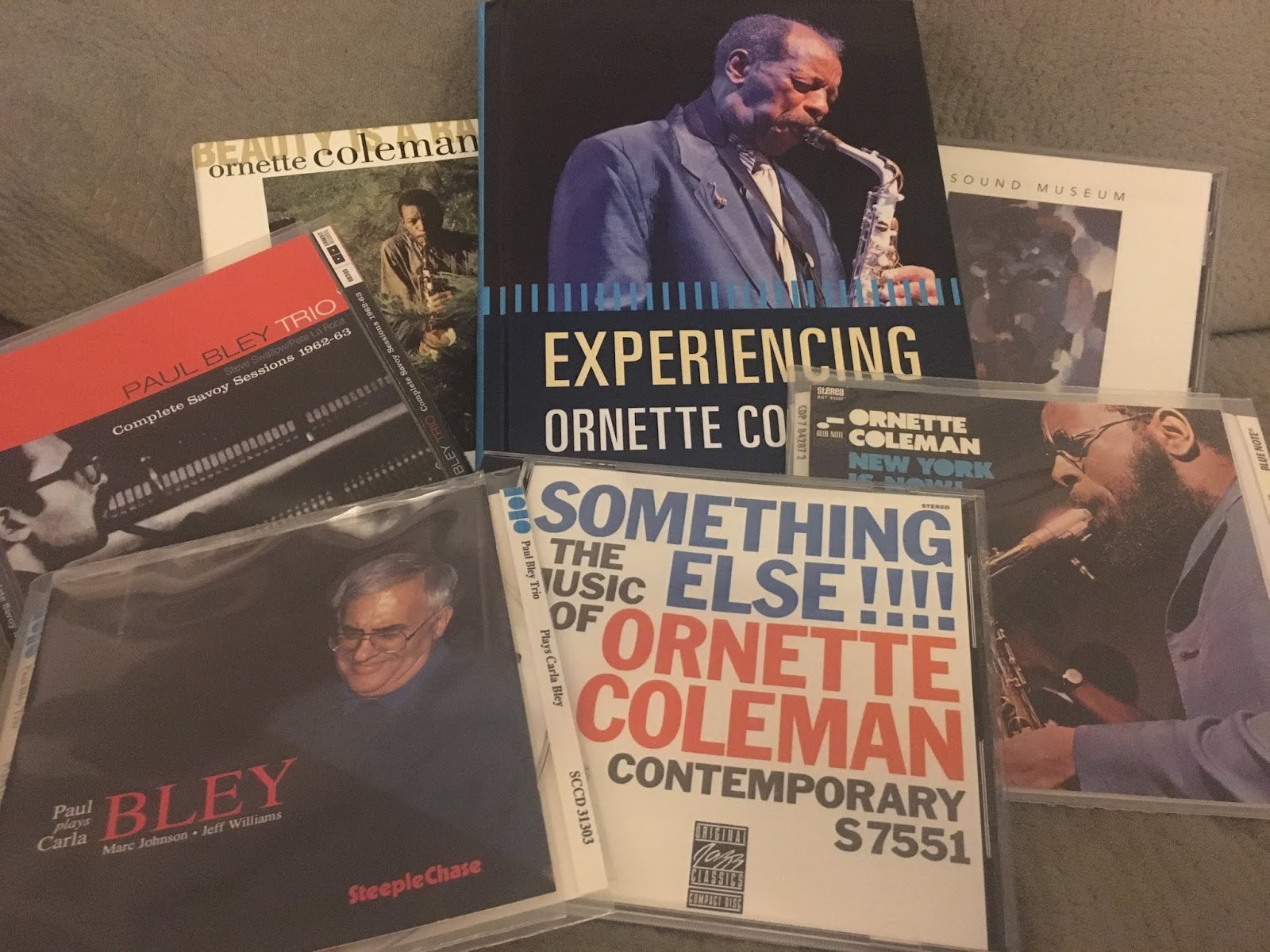
Recent listening: Some Ornette and Bley
Thursday, May 31, 2018
NZ Music Month: The 3-Out – Move
The 3-Out: Move
Mike Nock (p) Freddy Logan (b) Chris Karan (d)
Years before I heard Move, a friend (hi John!) played me a single track (possibly from a radio broadcast) blindfold test style. It was the 3-Out, and I picked Mike as the pianist. I'll put that down to an educated guess. I don't know if there are qualities on this recording that I recognize in Nock's present-day work. Perhaps I hear similarities in the energy and time feel... perhaps. The simple fact that I know it's Mike Nock makes it a bit tricky and easy to suggest things that are not really there. But something clued me in during that first listen.
Does his music conjure up images or feelings of New Zealand? Not so on Move, but on later recordings I do get that feeling. But again, the power of suggestion is at play (“Land of the Long White Cloud” from Ondas for example). Knowing he's a Kiwi leads me to making connections between his music and my own feelings/memories/impressions of New Zealand – whether it be landscapes, space, the light or the weather etc. If these connections exist only in my mind are they real? What I hear as reflecting New Zealand could easily be heard as something entirely differently by someone else (including fellow New Zealanders).
I don't get that feeling from other overseas based players such as Alan Broadbent or Matt Penman – so why do I get it with Mike? (sometimes I make that connection with Hayden Chisholm's music too) Maybe it's because Nock was the first jazz musician from New Zealand with whom I was aware, I latched onto that and projected it onto his music.
How about local jazz players invoking a New Zealand quality? The textual component of much of Norman Meehan's recent work helps, but you could debate how “jazzy” some of those recordings are. Jim Langabeer maybe (again with the power of suggestion re: song titles). And then there's the use of Taonga puoro. From the little I have heard of Jonathan Crayford's trio albums (they're on the list more a closer listen), they bring to mind some New Zealandness. But can it be NZ Jazz when two-thirds of the groups aren't Kiwis? I know that some entires for Jazz Album of the Year have been not seriously considered because they were recorded overseas with only one Kiwi. Thankfully Jonathan Crayford's win in 2017 for East West Moon seems to have put an end to that.
What is New Zealand Jazz? Does it invoke a particular feeling or imagery? Is it all just in my head? Is it even a thing? I lean towards no, and what I've heard from others on the subject, this is likely the consensus view at the moment - New Zealand Jazz isn't a thing, but jazz from New Zealand is. Perhaps, on some level, that's what this listening project is really about.
Move might sound pretty tame these days, but it pays to put things in context. From all reports this trio was at the fore of Australasian jazz. I stumbled on a couple of pretty interesting articles discussing that period of jazz in Australia, particularly the El Rocco – here and here.
I haven’t heard (m)any recordings from around this time to make comparisons. With the ease of recordings these days (not always a good thing!) sometimes you forget that once upon a time, musicians had to have someone willing to invest in them. That resulted in a lot of music not getting recorded. There is an interview with Mike where he talks about playing in saxophonist Bob Gillet’s band which was incorporating works by Kenneth Patchen - that’s something I’d like to hear! [Side note: Gillet, an American, was an important force on the jazz scenes in both NZ and Australia but I’m yet to hear a recording of him - is anything available?]
Anyway, it's great that the two albums from the trio have been reissued. Also reissued around the same time was Judy Bailey's 1964 trio album – lets hope for more. With these being Nock's first recordings of note, it's definitely one for Mike Nock fans or those interested in jazz in New Zealand and/or Australia in the late 50 and early 60s.
Well, this post took a somewhat unexpected turn. Thanks for hanging in there.
Friday, May 25, 2018
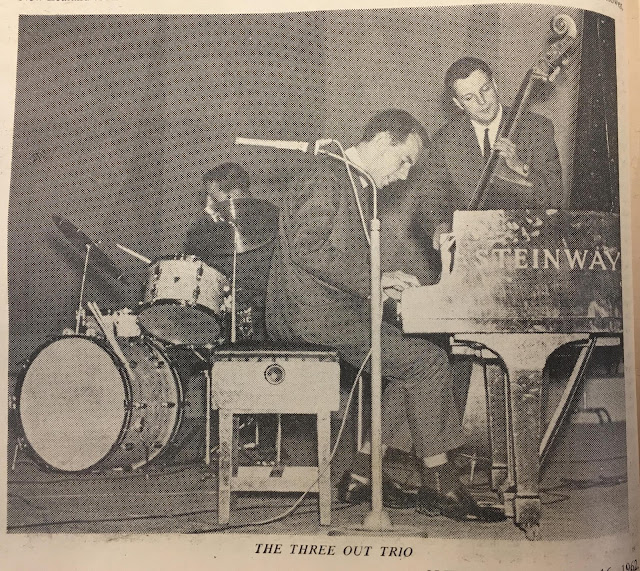
NZ Music Month: The Three Out Trio - Hot and Swinging
The 3-Out were featured in the March
16, 1962 issue of the NZ Listener. I remember hearing Mike mention that this was
the group everyone asked him about. I put it down to the records being scarce
(and expensive). Since then, both Move and Sittin’ In have been reissued and I
wonder if the Three Out questions have subsided? Anyone keen to try and track down the six
shows they recorded for NZBS?
Click on the image to view the full
article. More vintage magazine articles can be found here.
Subscribe to:
Posts (Atom)