
COVID-19 prevent the festival from proceeding as usual but the silver lining was that homegrown artists featured throughout. In addition, the festival commissioned works by four local artists and featured them as the headline acts.
Some might remember back when the Wellington Jazz Collective was directing the festival, they would commission a work to open proceedings. It's a great idea and moving forward, this should be part of the festival each year - a commissioned work by an New Zealand artist in a headline slot.
Here are some scribbles from the note book.
Wednesday 18 November
The Noveltones at St Peter’s Church
Since my return home, I’ve tried to catch The Noveltones whenever I could. I may not have got to them all, but enough to be pretty familiar with the group and the tunes. When I heard that Blair had been commissioned to write a piece for the festival and he was going to use The Noveltones to execute it – I added it to the calendar immediately. The quartet – Jasmine Lovell-Smith (soprano sax) Blair Latham (bass clarinet) Tristan Carter (violin) Tom Callwood (bass) – sounded great in the church.
The commissioned work was “Karla and the Divide” and for it Blair expanded the quartet to include Dan Beban (live electronics) and Andy (video art). The video definitely added to the vibe and ambience of the night, and I was particularly keen to hear how Beban slotted into proceedings. I was a little concerned how the added amplification would play out in St Peter’s, but I needn’t have, as the group sound with the electronics was great. Dan contribution to “Karla and the Divide” really set it apart from the rest of the set – adding subtle manipulations and gradually increasing them before eventually taking over responsibility for the ensemble sound altogether. Yet it was so well integrated, that somehow he managed to maintain the band’s sound – we were always listening to The Noveltones – not The Noveltones plus live electronics. Wonderful and a brilliant concert to kick off the festival.

AnthonyDonaldson (drums) Tom Callwood (bass) Dan Beban (guitar) Cory Champion (vibes/percussion) Steve Roche (trumpet/Electronics) David Donaldson (various stringed and percussive stuff) Blair Latham (saxes/b clarinet). This ensemble had a residency at Meow following the lockdown but I never managed to get along. And although it was going to make for a very long day, I didn’t want to miss out. The residency had paid off as the group was sound very together (and the lack of sheet music was refreshing). Blair, straight off the back of the Noveltones gig (Tom and Dan too) was in fine form – he even busted out the alto, in addition to his usual tenor and bass clarinet. I really didn’t have too much of an idea of what I was going to hear, and following what I’d heard early in the evening, I easily could have been disappointed. I wasn’t. It was fun gig with great energy and just the right amount of zaniness.
Thursday 19 November
Kevin Field at St Peter’s Church
When it was announced that St Peter’s on Willis Street was going to be the venue for the Wellington Jazz Festival, I was suspicious of its suitability as a venue for jazz. And on Thursday night those suspicions unfourtunately became reality. Usually, I try to stay pretty positive on the blog but here’s bit of a rant.
I’m not a huge fan of this type of jazz (slick mainstream contemporary is I guess could be the pigeon hole), but I was keen to check out what Kevin had to offer – and he had assembled an interesting line up: Kevin Field (piano/Rhodes), Nathan Haines (tenor/soprano/flute) Keith Price (guitar) Lewis McCallum (bass clarinet) Cameron McArthur (bass) and Stephen Thomas (drums).
Good live sound would have gone a long way to get me on board. But sadly, it was a mess - bottom end boom and lack of clarity, combined with a bright and thin top end (guitar in particular suffered on this front... my first chance to hear.... and it didn’t leave a positive impression). The soprano sax and flute of Nathan Haines fared pretty well in the mix and it was nice to hear him live again. The bass was less fortunate – a muddy mess. Early on, Kevin’s piano was lost in the wash to the point where someone asked me if the piano was even going through the PA (it got better as the concert progressed). The woodiness of the bass clarinet had pretty much been stripped (but who knows, maybe that’s not part of Lewis’ sound). The drums were a total mess and Stephen Thomas’s super-busy playing style really didn’t help the cause at all. The bass drum sounded like a neighbour pounding on the wall to get you to stop practicing (you ignore them, and the pounding continues.... and continues). In general the band sounded over amplified. Maybe on the bandstand things sounded okay (I’d be keen to know) but out front it sucked (I was sitting one seat behind where I was the previous night - good seats). At lower volumes things were okay I guess, but those moments were few and far between.
For me, it was a distraction from the music, and any chance of subtly was lost. It’s a room issue really (Church acoustics 1 – Jazz band 0), and I felt for whoever was handling sound, they had an up hill battle and probably would have been better off turning the PA off and letting the band sort it out for themselves!
At the end I turned to me old mate JJ and said, “Well... that dead horse is well and truly flogged.” In some ways I feel I shouldn’t complain, as we’re the lucky few who can attend live music, but this was a disappointing evening. For the people I was with, this was there introduction to Kevin’s music, and they left pretty deflated. Hopefully it won’t turn them off his music. I briefly entertained the thought of catching a late night set somewhere... but didn’t. I talked to someone else the following day, and they made no mention of any live sound deficiencies and were quite full of praise – mentioning Field, Haines and McArthur’s in particular.
To be fair to Kevin Field, he received the commission before the venue was announced. Whereas The Noveltones suited in that acoustic space, Kevin Field’s group didn’t. And it left me wondering how Riki Gooch’s group would sound the following night.
Also, the crowd was a noticeably different demographic than Wednesday – an older crowd for sure and a lot less familiar faces.
Friday 20 November
Riki Gooch at St Peter’s Church

I couldn’t get along to Riki’s Arthur Street Loft Orchestra gig, so I made a point of committing to this one early on. It was fantastic to have a sell out for something pretty adventurous and far from mainstream (Riki is a known entity beyond jazz so that probably helped). His piece “Ngā Tuone” was a conduction for a 12 piece ensemble.
The programme notes put a smile on my face and hinted at things to come it terms of mood. “We have no music notation, scores, charts or predetermined musical ideas as such. But, before you start thinking ‘did I just blow 39 bucks and my Friday night out on this s**t, I have taught the players a series of hand gestures and signs that symbolise music notation”... Gold. So there was an aspect of fun involved, even some audience participation (cued rustling of the programme... it actually worked too). Riki has a great stage presence, and his conduction gestures took on a dance-like quality at times (or maybe a martial arts vibe) that made for a nice visual element. At times the gestures were subtle (a quick cue to a particular musician), other times they flowed (full body movements directing shifts in dynamics). And then there were the table tennis balls... bounced, tossed, and flung high into the air. The visual element was certainly entertaining but, importantly, it did serve the music.
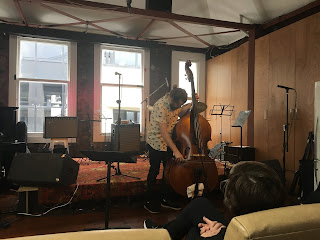
There was plenty of variety – dynamics, density, textures, time etc – that kept things engaging and moving along. In fact, I couldn’t believe how quickly time passed. For me, that means things worked. Riki’s choice of musicians was one of the keys to the success – flexible, imaginative, open. I had high hopes for this concert and I didn’t leave disappointed. Quite the opposite.
 Following that, I didn’t feel like listening to another gig that night. Meanwhile the weather had turned to crap, if I had my horn with me I would found a dry spot and had a toot. Instead, I mellowed out at home.
Saturday 21 November
I gave the headline series a miss on Saturday. The downside of festivals is you can’t get to everything. I heard very good things about Anita Schwabe’s Sextet (and it sounds like they sorted out the sound issues). I haven’t heard how the Avantdale Bowling Club gig was yet. But I did manage to get to a few things.
Tom Botting at Third Eye
Started off the day with some solo bass. Tom was talking about and demonstrating various techniques on bass (multiphonics/harmonics etc etc). It was really interesting, and nice to hear someone using ‘extended’ techniques to play “pretty” music (although a little grit wouldn’t have hurt!). The only thing I found disappointing was he only played some prepared etudes he developed as a means of learning the various techniques, and I would have liked to hear him improvise with them.
Royal New Zealand Air Force Jazz Orchestra at Te Papa 
 Hot Ostrich at The Library
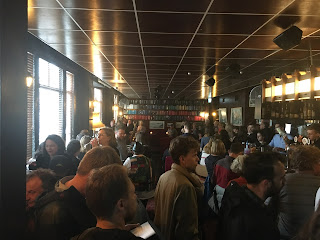
Ed Zuccollo (keys/synth) Blair Latham (tenor sax) Peter Elliott (drums) These guys play here on a pretty regular basis but I haven’t managed to get a long until this earlier than usual set. The bar was packed and I wasn’t really in the mood for that Saturday evening, packed bar, cocktails thing. But I hung out and had a listen nevertheless. Definitely a group I want to hear again, maybe when the scene is a little more low key.
GRG67 at Third Eye
Roger Manins (tenor) Michael Howell (guitar) Mostyn Cole (electric bass) Tristan Deck (drums). I came knowing what to expect and didn’t leave disappointed. If you’re looking for some contemporary tenor saxophone shreddin’ in New Zealand, nobody does it better than Roger Manins (but he’s much more than just a shredder). I got along to the first set and they were sounding on form playing tunes from their latest recording, Happy Place. It’s pretty rare that I enjoy electric bass, but Mostyn really takes care of things in this group. Really solid gig, but the crowd was on the small side – no more than 30. I was expected more, but that can be the downside of festivals with clashing timeslots. I wonder what the turn out was for the second set?
 I was planning to go to Clear Path Ensemble but due to sleeping like crap from the last few night and my allergies kicking during the afternoon, I got down to the Meow and then decided to bail.
Sunday 22 November
Jazz Kōrero at Rogue and Vagabond
This year the topic for the discussion was “Jazz and Accessibility”. I felt it was pretty flat and just couldn’t really get into it. I’ll leave it there.
HSK III at Southern Cross
I only stopped in here for about 20 mins as I made my way to Jasmine’s gig. I wouldn’t mind hearing this trio again - Hikurangi Schaverien-Kaa (drums) Callum Allardice (guitar) Tom Botting (bass). This gig definitely had a chilled out Sunday afternoon feel about it, and while they sounded good, I’d like to hear them in a more high energy setting. But I was probably hoping to hear Tom employ (deploy?) some of the techniques he demonstrated on Saturday. It didn’t happen while I was there, but I dug his bass lines.
Jasmine Lovell-Smith Quartet at Whistling Sisters
During the festival, Whistling Sisters presented the series Wellington Women of Jazz. Whenever possible, I try to get out to hear my friend Jasmine – gotta support a fellow soprano player! Plus I was curious to see how this space worked for jazz. I was pleasantly surprised – the balance was really good (the band deserves plenty of credit). As with last time I heard Jasmine, Emma Hattaway was on bass. She’s a really good fit for Jasmine’s musics. Ayrton Foote was on keys (the downside of a lack of pianos in venues... maybe the festival could sponsor getting pianos into venues?), I’ve heard him a couple of times recently and want to hear a bit more. Jasmine’s music seemed new to him, but he handled it okay. I hadn’t heard James Feekes before and he demonstrated tasteful restraint that was very venue appropriate (wisely, he didn’t push the volume levels). Very nice to hear Jasmine un-mic’ed and the room brought out the singing quality in her tone.
 Now! at the Third Eye
A few final thoughts.
The headline concerts provided plenty of variety (they were recorded by RNZ so keep an ear out for them)
Moving forward: keep commissioning local artists. Give them headline spots AND time to rehearse. It will really help develop the scene. Drop the church (unless the music suits that acoustic environment). I get that the festival was thrown into chaos with the pandemic and there were probably limited options, but the headline venue needs to be acoustically suitable.
Low points: live sound at Kevin Field and the usual festival time clashes.
High points (lets end on a high): The Noveltones and Riki Gooch. Not having to rely on 'big' name internationals to fill venues or give the festival credibility.
And remember..... there's jazz happening all year round - not just during the jazz festival - get out and support it! ...cue Fred Dagg.


