Showing posts with label jazz improvisation exercise. Show all posts

Wednesday, April 22, 2015

Notebook 3: Yusef Bergonzi

A couple of weeks ago I was flicking through my old practice notebook. I came across a couple of pages of notes on rhythm exercises from a time when Yusef Lateef's Repository of Scales and Melodic Patterns found a regular slot in my practice time. Although there is quite a bit of rhythmic variety throughout the book, I took some of the lines and started applying them to rhythms from Jerry Bergonzi's Inside Improvisation Volume 4: Melodic Rhythms.

I have notated some examples below, although when I worked on this I did not write out anything - I just internalised the rhythms and applied them to the original lines. I worked on this with and without using a metronome. You may want to use a play-a-long recording.

It's a simple idea really - take a rhythm and apply it to melodic material. It can be a nice way to break up practicing everything in streams of 8th notes or triplets. The same melodic material can sound very different when it is changed rhythmically. Although the examples of the melodic & rhythmic material below come from books, feel free to create your own.

Here are a few examples:
Excerpt from Repository of Scales and Melodic Patterns (page 3) - "Major Triads in Cycle of Down a Major Third and Up a Perfect Fourth"

Two of the "22 Rhythms" from Inside Improvisation Volume 4: Melodic Rhythms (page 16).
22 Rhythms
Combing the first line of melodic material with the first rhythm:

Jazz Improvisation Exercise
Combing the second line of melodic material with the second rhythm:
Jazz Improvisation Exercise
Once you feel comfortable playing the lines with two or three different rhythms, start alternating between the different rhythms.

The next example uses a hemiola rhythm from Jerry Bergonzi's Melodic Rhythms (page 67)
Hemiola
The hemiola applied to the Yusef Lateef excerpt.
Jazz Rhythm Exercise Hemiola
A little later on, I did the same with Volume 5 in the Bergonzi series: Thesaurus of Intervallic Melodies.

I also combined melodic material with the rhythms of melodies. Here the line(s) above are combined with the melodic rhythm of Charlie Parker's "Billie's Bounce." I'm using the rhythm as it appears in the Charlie Parker Tune Book by Fred Parcells (which you can download for free on his website). "Relaxin' At Camarillo" would be a nice one too - use any melody which appeals to you rhythmically.
jazz rhythm exercise
Here, the Bergonzi intervallic lines are applied to melodic rhythm of "Billie's Bounce." Before jumping in make sure you have a solid grasp of the melodic rhythm - you may even start by playing it on one note (from memory, Steve Lacy mentions this in Findings).
billie's bounce intervallic melody
Start off slow and build into it. Once you feel comfortable applying predetermined notes to the rhythms, start improvising your note choices with the fixed rhythm(s). As you can image, the rhythmic variations on a line are endless.

I used the free music notation software Muse Score to create the examples above.
Previous posts from my notebook can be found here: Old Music - New Music & One Free Note.

Monday, November 10, 2014

Practice Journal: 3 November 2014

Last week I was sick so I gave playing a rest. The week before I wasn't that diligent with the note taking but now I'm back into it. Although my notes were a bit thin on detail earlier in the week, I tried to make sense of them as I wrote them up.

Monday:
Terrace Dynamics
Overtones
Todays lesson - find a better time to practice (not 25 minutes before your wife has a conference call!), the horn was too loud but I could work on rhythm, so I tapped out some patterns in Pure Rhythm.

Wednesday:
Spent about 15mins on each of the below.
Letting It Fall and Overtones
Modus Vetus - sing and play 1 phrase in all keys. I noticed that my singing this week was a bit rough. Sstill feeling the effects of last weeks cold, I lost a bit of the higher range. It got better as the week progressed.
Etude - Balkan piece. Not exactly sure of the origin of this tune but it was given to me by Hayden Chisholm in Greece. I hadn't working on this for quite some time but it just popped into my mind so I decided to have a crack at it again.
Improvisation - playing 5 and 7 note phrases

Thursday:
Rascher's Top Tones - playing through page 12.
Modus Vetus - sing and play 1 phrase in each key.
Balkan piece - breaking it down a phrase at a time.

Friday:
Long tones (F's and C's)
Letting It Fall.
Overtones and Rasher (parts of page 13).
Modus Novas - sing and play - it's been a while and I was rusty.
Modus Vetus - the tonal stuff came together better
Balkan Piece.
Improv - short phrases. To avoid compulsive playing I would put the horn down briefly after blowing a few phrases. I found it a nice way to stay relaxed and to reflect on what I had just played before moving on.


Saturday:
Held some long tones - used a tuner. Not something I do that often (I prefer playing against a note/drone). But I might stick with this a bit to see what happens.
Letting It Fall
Rasher book - about half of page 14.
Modus Vetus - sing and play 1 phrase in all keys (descending chromatically).
Balkan Piece - working through it slowly. Having bit of a hard to memorising it.
Improv - similar to above (shorter phrases, trying to avoid compulsive playing and then let longer phrases and more dense playing develop from there).

Sunday:
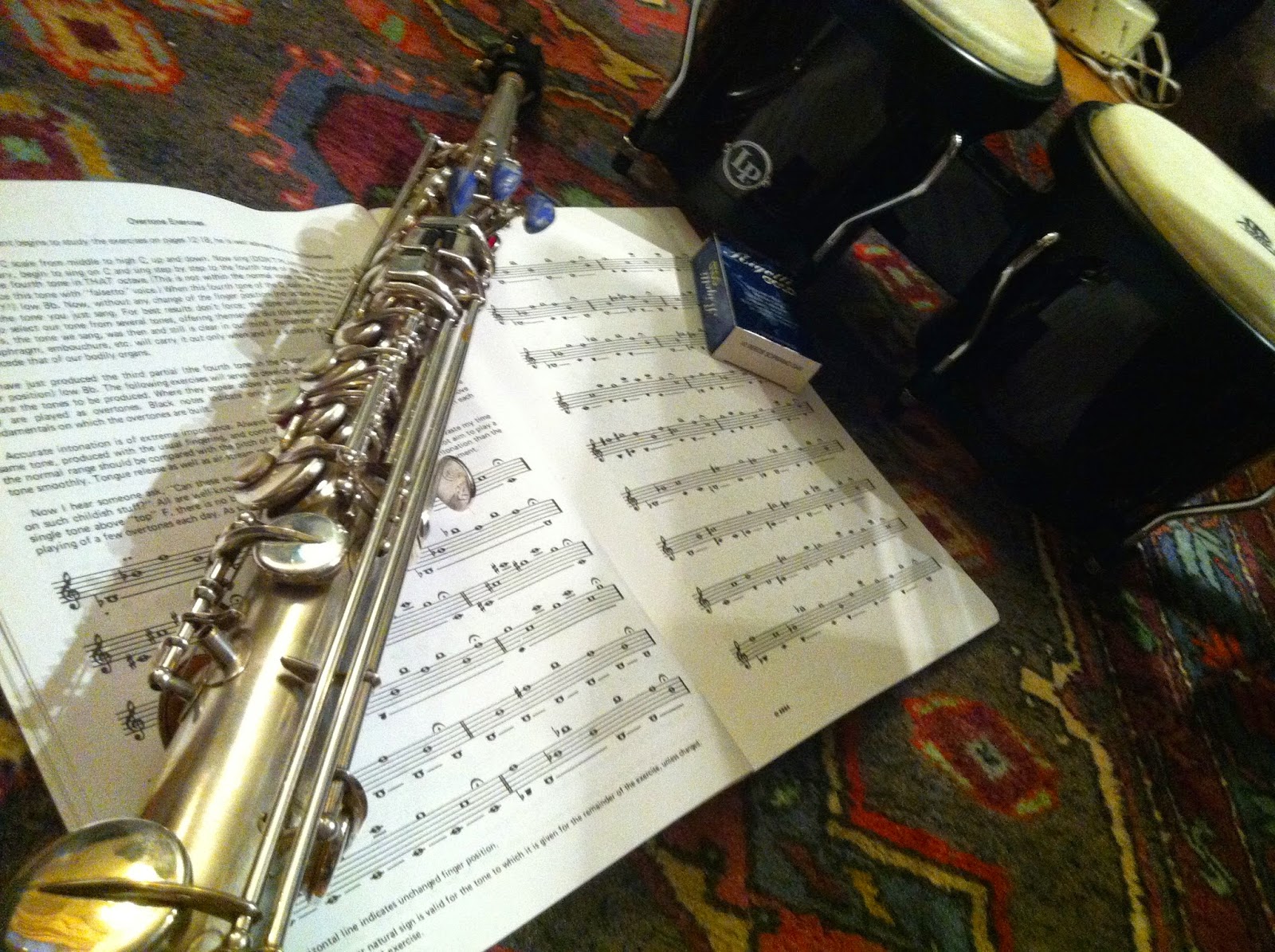
Today I worked on rhythm in between each of the below. Working on the the Ewe bell patterns from Pure Rhythm (playing them on bongos). Working on the first rhythm and then the 1st variation in which the quarter note pulse shifts to the middle triplet (trying not to turn the beat over!).
Long Tones with Tuner.
Letting It Fall and tone matching
Rascher book - first half of page 14.
Modus Vetus - sing and play 1 phrase in all keys (descending chromatically).
Modus Novas - sing and play 1 phrase (ascending chromatically). My focus started to drift after working through about 4 keys. So I moved on to something more casual - listening and at times playing along with the Agios Lavrentios Brass Band video from this years Music Village.
Finished things of with some improvising.

I haven't recorded myself practicing for a while so I adding that to the list.

Monday, October 20, 2014

Practice Journal: October 13, 2014

Here's what was up last week. For previous entries see here and here.

Monday:
And now for something completely ... slightly different..... An hour (or so) of tunes. It was getting late in the evening by the time I had a chance to play and I felt like playing some of my favourite tunes - "My Melancholy Baby," "All The Things You Are," "These foolish Things," "Out of Nowhere," "I'll Remember April" and "What Is This Thing Called Love."
There was straight melody, improvising on the form, free improvising, improvising on the song phrases (length of phrase) One thing I didn't do (but occurred to me as I was drifting off to sleep) was improvising on the melodic rhythm of the tunes. This is something I want to explore further.
===

Tuesday:
Warmed up listening and playing with "Wild is the Wind"from the Connie Crothers/Bob Casanova album Just For The Joy Of It. I'm not sure what made me head to this tune today, it was in my head so I went with it. Today I listened to the tune a couple of times (just the melody chorus) and then played along adding in notes here and there - not really really working it out, just feeling things out.
Modus Vetus - 1 phrase in all keys. Singing and playing.
I followed this up with a bit more of "Wild Is The Wild" - getting bit of a feel for the melody on my horn.
Tried to do some work with Modus Novus but after about 5 mins it just wasn't happening so I scrapped it and so improvised a little before moving onto Bach Invention #2. I was a little tied sounding at first but things picked up as I dug into it.
I finished things of with a little bit of improvising - held tones and economic note usage. And wound up the night with what I could play of "Wild." 
===

Wednesday:
Quiet long tones - various notes held out at lower dynamic ranges.
Modas Novus - 1 phrase interrupted with the arrival of the plumber.
Overtones - page 13 from the Rascher book (not too bad considering I picked up the horn cold).
Bach Invention #2
Pure Rhythm - page 5, variation 4 on the bongos.  Then alternated between playing some rhythm and then playing Bach Invention 2. This was interesting and I think I will do more of this.
I ended with bit of a noodle and came up with an idea to improvise a group of notes (say 5 notes) and repeat it, then change 1 note (and repeat the new configuration), then change another note (and repeat the new configuration) etc etc. Maybe something to delve into later on down the line.
===

Thursday:
Quiet long tones - a few to ease the reed in and get some air in the horn.
Melodic Rhythm - took the melodic rhythm of "My Melancholy Baby" and improvised the notes. I want to explore this further.
Modas Novus - sing and play 1 phrase in all keys (chromatically). This is the one I could get into the other night but this morning it wasn't too bad.
Overtones - page 14 of the Rascher book. Today I was trying to play them quietly.
Alternating Bach Invention #2 with work from Pure Rhythm (tapping on my legs variation #4 on page 5)
===

Friday:
Singing and playing with "Wild Is The Wind." Today I listened and then sang with the melody. Then broke it down into phrases that I would sing with the recording then try and play on my horn, the play on the horn with the recording before moving onto the next phrase. This is how I often go about learning melodies.
Pure Rhythm  variation #4, 5 and 6 on page 5.
===
Saturday:
Singing with "Wild Is The Wind"
Rhythm - variation #4 alternating counting in 3 and 4. This morning I alternated between whatever I am working on and some rhythm stuff.
Modus Vetus - 1 phrase in all keys around the cycle of 4ths. Currently I'm working from the 3rd to the root.
Rhythm - started on variation #5.
Modus Novus - 1 phrase in all keys descending in Major 2nds.
Sound work - Letting It Fall and page 14 from the Rascher book. I played most of the page today - more than I normally would on it but I was on a roll.
Bach Invention #2. Felt like it was coming together today. Played it at a few different tempos.
"What Is This Thing Called Love" - taking the songs melodic rhythm and improvising the notes. This is a lot of fun and leads to some different places. Sometimes I found myself taking a few too many liberties with the rhythm - it's hard not to get carried away.
To finish things off I played around with the idea I came up with on Wednesday - improvising then altering groups of notes.
===

Sunday:
Rhythm - alternating counting in 3 and 4 on variation #5 and #6. Usually I find adding the count in throws me off. More to work on!
Sound - Letting It Fall (a great place to start). Page 14 from the Rascher book - today I focussed on just a couple of lines. Playing on only the mouthpiece (chromatic scale, major and harmonic minor scales, some arpeggios).
Modus Vetus - 1 phrase in all keys (sung then played as usual) around a cycle of minor 3rds.
Modus Novas - as above but in Maj 3rd cycles.
"Wild Is The Wind" - alternate singing a chorus of melody and playing a chorus of melody. Sometimes I muddled the lyrics so a sang with the record a couple of times to straighten me out.
===

Friday, October 10, 2014

Practice Journal: 29 Sept 2014

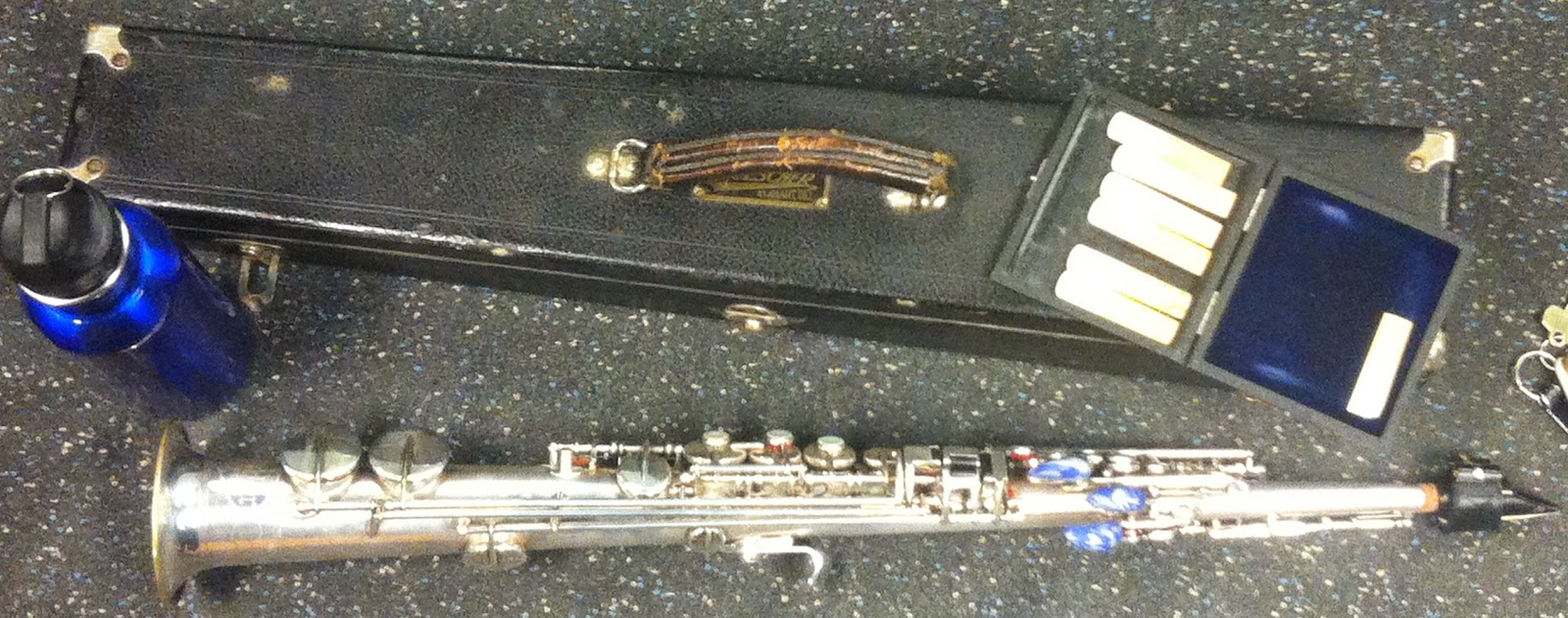
I've kept a practice journal periodically ever since I was at university. They come and go and vary in detail.  Last week I started a new one possibly sparked by the arrival on a new soprano (a Buescher True Tone) a week or so before.

It's been fun getting used to the new horn. Overall the ergonomics are not nearly as bad as some would lead you to believe. The transition between low B & C# is taking a bit of getting used as are the different fingerings up top (not front f key). I haven't really looked into the quarter tone fingerings but I know I will need to make some changes as the mechanism is different. I've found that getting the horn well warmed up helps the intonation tendencies to settle down a bit. Here's a rundown of the week.


Monday
Sound:
Terrace Dynamics (a la Sigurd Rascher's Top Tones for Saxophone) on Low E.
Rascher's "Uniformity of Tone Character" - worked between low A and middle F.
Descending octaves without the octave key (aka Letting It Fall) from Low F-Bb
Overtones. Up to third overtone. Including tone matching the regular fingering with 1st, 2nd and 3rd overtones.

Ear Training:
Modus Vetus - taking a line, singing and playing it in all keys (and registers) (round the cycle of 4ths)
Modus Novus - ditto (in whole tones)
I've had these books a little while now but have only just started working with them. Expanding on the work I have done singing/playing interviews and chords.

Tune:
"September In The Rain." This tune popped into my mind one day (perhaps it was raining) so I felt it was a good sign to start working on it.
Looped melody, sang melody, played melody in a few keys. F, C#, G.

Rhythm:
All of these were played on bongos.
Warmed up on a 6/8 rhythms - counting 4/4 and 3/4 against the 6/8 accent.
Revised 3 over 2 and 3 over 4 (and vice versa).
Bell pattern over 4 pulse.
===

Tuesday
Letting It Fall
Overtones and tone matching
G with iTablaPro drone. Terraced dynamics, swells. then G and D (all registers) against drone.
Mouthpiece only - chromatic scale up and down. major scale up and down. Range is about a 10th

Sing with Nate King Cole "Star Dust"
Roy Eldridge "Star Dust" - singing with his solo (at half and full speed).

Modus Vetus - sing and play a phrase in all keys. Used iTabla Pro as a metronome.
Modus Novus - sing and play a phrase in all keys.

"September In The Rain."
Sing with Frank Sinatra
Alternate Playing Melody and sing melody.
Started learning harmony.
===

Wednesday
Rhythm - 6/8 and some 3 over 2.

Dynamics on high G
Tone Uniformity - middle F- high Bb. 
Letting It Fall
Overtones. Lots of tone matching overtone to regular finger (up to 4th overtone)

Modus Vetus 1 phrase round cycle of 4ths
Modus Novus 1 phrase round diminished cycle
September in the Rain melody in keys of E, Eb

Tune - "September In The Rain"
Alternate singing and playing the melody. Root Progression of Harmony. Outlined harmony - no set patterns - some choruses were in time others were rubato. Alternated melody with free improvisation.

Sing - Roy on "Stardust" (1/2 and full speed)
===

Thursday
Started today singing with Roy Eldridge on "Stardust."

Letting It Fall. I find this a nice place to start and find myself returning to it during practice sessions when I want to clear my mind or relax my embouchure.
Bending notes - taking a note and lowering it a semi-tone, whole-tone, minor third, as far as I can go with it. Taken from Steve Lacy's book Findings - I forget what he calls the exercise.
Mouthpiece only.

Rhythm - 6/8 counting 4 and 3.

Modus Vetus - 1 phrase in whole tones.
Modus Novus -1 phrase in min 3rds.

"September" - sing/play melody, outline the harmony. Improvise on the tune to finish things off.
===

Friday
Rhythm - alternating hands between 4 pulse and bell pattern. Worked on this throughout the day in short spells (taking a break from school work, practice break etc).

Warmed up with a couple of minutes freely improvising.

Modus Vetus and Modus Novus - one phrase each in all keys around the cycle of 4ths.

"September" - alternating sing one chorus, play one chorus. This always brings back memories of my lessons with Richard Tabnik.

Singing with Roy's solo on "Stardust." My version seems to be a semi-tone-ish high. I found some versions on youtube that seemed to be at the correct pitch. I may switch over to those versions.
===

Saturday
Warmed up looping the melody of "September." I then returned to work on tune in various ways (melody/singing/Harmony/Improvising) in between my other work.

One phrase from Modus Vetus in all keys moving up in whole tones.
"September"
One phrase from Modus Novus in all keys moving down in whole tones
"September"
Overtones - Once I worked with the first 3 over tones of various fundamentals I focused a little on the top end (4th/5th/6th overtones) off Bb fundamental.
Mouthpiece only.
"September"
Rhythm - bell pattern , alternating hands, various tempos
===

Monday, August 12, 2013

Notebook 2: One Free Note

Here's part two from the Notebook Series (Part one is here).  

This exercise was part of my lessons with Richard Tabnik. What struck me was the simplicity, fun, and effectiveness of Richard's ideas.
Symphony for Jazz Trio
He introduced this exercise to me when we started working on free improvisation. It most definitely had a flow on effect when I played tunes too - loosening and opening up the lines I played. 

Over the years I have worked on it by myself, with friends (great for duos), used it as a daily warm up, and applied it to tunes (this is something I want to do more of). 

Start with a single note. Hear and feel the note. Play the note - it can be loud, quiet, long or short - whatever you feel in the moment.

Relax, breathe, listen and play your next free note.

The note is what it is in that moment - don't aim to control it. Let it be free. Listen to it as you play. 

Stay playing single notes until it feels right to move on to two notes - Don't rush, take your time.

Now's the time for two free notes. The process is the same. Play the note you hear in the moment, listen to that note and then play your second free note

Hear and feel the note-to-note connection between the two notes!

Relax, breathe and listen before moving onto your next two free notes. It becomes quite meditative.

Again, continue until it feels right to move on to three free notes. And so it goes on through up to seven free notes - phrased in one breathe with rhythm, articulations, dynamics, tempo etc as you feel them in the moment.

Once you spend some time playing seven free notes it feels quite natural to move into free phrases - these do not need to be more than 7 notes (they can be though).  Approach the free phrases the same way as you have the 1-7 notes groupings.  Relax, breathe, listen and then play a free phrase - repeat.

Working your way back down from free phrases to seven free notes all the way back to one free note can be a blast. How does playing one free note differ now to when you started?

Find someone to trade free notes with - this is a blast. I have done this with a couple of friends, working from one note up to free phrases. Just simply trade notes - you play one free note, they play one free note etc. Eventually one player will change to two free notes, then three free notes and so on.

As I said earlier, this was passed onto me by Richard Tabnik - a wonderful alto player. Be sure to check out his music. His latest recording is Symphony for Jazz Trio (New Artists Records 2012) with Adam Lane (b) and Roger Mancuso (d) - a 2CD set featuring live and studio recordings of his three movement work "A Prayer For Peace" (plus half a dozen other pieces too).  His work and teaching have had a profound impact on me - Thanks Richard!! 

Here's the original notebook page typed up.
=============================================================================================
* One Free Note (RT) *
  • Play It => 1 note! (could it be any easier?)
  • Hear It
  • Feel It
  • Long, Short, Slow, Fast
  • FF, pp
  • Free It
  • Sing It
  • ! Be Relaxed !
  • 2 Free Notes, 3, 4, 5 etc (up to 7)
  • One Free Phrase (hear it, feel it)
  • Another
  • Another
+ Great to play/trade with another person/other people
+ Try it when playing a session/on a tune
+ By the time you have done 7 free notes for a while, Free Phrases will naturally flow - trade Free Phrases with someone.
+ After playing 1, 2, 3 etc Free Notes after Free Phrases work backwards... Free, 7, 6, 5 etc to 1 - it's quite a different feeling.
============================================================================================