Showing posts with label saxophone trio. Show all posts

Friday, January 01, 2021

Jazz | Pint | Warne Marsh

North End Brewery Salt and Wood
I thought of this set of recordings last night when I was playing on the street (accompanied by the sounds of fireworks and New Years revelers). Back in the day I used the money gained from playing on the street to feed my CD habit. One such purchase was the Mosaic Records set of Atlantic recordings by Tristano, Konitz, and Marsh. It took some saving up as I never made much money (mostly I was just practicing) and I remember the exchange rate really wasn't in my favour either! In fact, it way have been the first thing I purchased online.

When I got the set, it was the solo Tristano and Warne's albums that excited me the most. And that's probably still the case, although now I appreciate the contribution of the rhythm sections far more. I think that back then I was so taken by Warne - especially his tone - that the others just faded into the background. Tonight, I spent a bit of time just digging the lines laid down by Paul Chambers and I was still able to marvel at Marsh. There are other albums I was really into back then, that when I hear them these days just don't resonate with me nearly as much. Whereas Warne's self-titled Atlantic album has got better with time. It's funny, as what were favourite tracks over 20 years ago are still my favourites today (well they are tonight anyway!) - "Yardbird Suite" and "Excerpt". "My Melancholy Baby" is great too as is "Just Squeeze Me" and makes me wonder why I'm playing favourites tonight. It always pains me to look in the liner notes and see listings for other tracks from these two sessions... "unissued, master no longer exists". We can only imagine. The upside is that we do have six tracks, and if you haven't heard them, please set aside 35 minutes and give it a spin (or you could just put it on loop like I did tonight).

While I may not listen to this music as much as I once did (for a long time it was a daily occurrence), this music still travels with me. A great way to kick of what was otherwise a quiet start to 2021.

Wednesday, August 01, 2018

NZ Jazz: Vibrant Tongues - The Shadow Out of Time

Vibrant Tongues: The Shadow Out of Time
Blair Latham (ts) Tom Callwood (b) Reuben Bradley (d) 2006


Up until now, this project has focussed on filling some gaps in my listening. So I why did I choose an album that wasn't new to me? Aside from it's nice to revisit albums once in a while, I don't really know. Somewhere along the way the CD developed a glitch on the last two tracks but thankfully it ripped onto the computer without a problem. I pulled a pile of NZ jazz albums off the shelf and for whatever reason, here we are, with The Shadow Out of Time.

New Zealand Jazz
I remember listening to this album quite a bit after picking it up at the CD release gig (at Happy) but it has been a long time between listens. I couldn't really remember any specifics, but the overall vibe – a dark quality, yet energetic – was still firmly in my mind. It was the more up tempo pieces that had left that impression. I hadn't remembered the ballads being as strong, but I gave them a closer listen this time around and they went down nicely. They offset the more outwardly energetic pieces and bring variety to the album that I had forgotten. Blair and Reuben share the composition duties (with five and three respectively) and there is plenty of continuity between the two, creating a nice flow to the album.

At times the Tom Callwood's bass is a little low in the mix or it's probably more of a case of the tenor being too high. It could lead a listener to miss some of the subtleties of the important role he plays in the trio. On the upside in did cause me to tune in to the bass more closely. Mixing broken time, walking and double stops provides a welcome disjointed feel to “Mad Uncle” with the drums joining in as the sax swings along energetically. Around the 2 minute mark on “I Dare Hear” there are some nice, somewhat unexpected bass interjections that popped out at me. Tom's solo on “3 4 5” sets up the transition back into the final melody statement (this time taking a rubato approach – nice touch). Much like his work on “Asturias” on West of the Sun (see the last post in the series), the solo bass intro on “Search In Progress” does a great job of establishing the tone of the piece. The ostinatos (with variations) are an important factor in “Shimmering Sunset” and “Wanna Get Happy?” Not one for flashy pyrotechnic displays, Callwood is a creative accompanist and soloist who gets to the essence of the compositions and I find that makes far more interesting and enjoyable listening.

Back in my alto days (daze?), I remember being a little disappointed when Blair made the switch from alto to tenor, but that seems a long time ago now (I guess it was in the early 2000s). The album opens with “Make It Quicker” and Blair comes straight out of the blocks full steam ahead (and Rueben latches on to Blair’s energy throughout).Blair's playing contains a certain quirkiness that I find very appealing (and the quirkiness doesn't become gimmicky). His tone is resonant (vibrant) with a bit of bark and well as a cry. At times a vocal quality comes to the fore. The growl is well integrated into the overall sound and doesn't really sound like it is just pasted on (“and now it's time to growl”). Instead, it's part of the natural development of the line and feeling (I feel even Coleman Hawkins fell into the trap and overdid it). There is an exuberance to his time feel (almost a bubblyness) which makes for an interesting contrast with the darker qualities of the music. On “Wanna Get Happy” his lines are scattered and energetic and his tone almost splits as he attacks notes on “I Dare Hear” whilemixing up a swinging swagger with darting double time lines to great affect. There's even a little atmospheric bass clarinet during the intro of “Shimmering Sunset” before he switches to tenor for a very well-paced solo to round out the album.
I haven't heard Blair live for quite some time and he hasn't recorded all that much (this is the only recording I have and I must seek out others). But listening to The Shadow Out of Time has made me want to hear more. He doesn't really sound like any other saxophonist that I can think of..... and if this music is about developing a personal sound and approach then Blair is ticking those boxes. It's definitely not your garden variety, clean, generic modern tenor playing.

Reuben has established himself as one of the top jazz drummers in the country but I'm afraid to say that I haven't had a close listen to much of his recorded work. I'm keen to listen to Shark Variations (with Roger Manins and Brett Hirst) to hear him in another sax/bass/drums setting some 10 years after The Shadow Out of Time. At times he can quite busy but without cluttering or dominating even as he builds intensity throughout a piece as on “Wanna Get Happy?” On “Shimmering Sunset” he draws out some different colors and there's airiness to his playing that remains present throughout, even if only hinted at, as the piece develops. These days Reuben is based in Australia but hopefully he gets back regularly as I've always found him to be a positive force in the NZ jazz community. In fact, he played (with Blair) while I was back but I was unable to get along. Next time!

While this series was originally about discovering new music, revisiting The Shadow Out of Time has been time well spent – I'd forgotten how much I enjoyed this album.

Thursday, October 06, 2016

Lambic Jazz Vol. 4

saxophone trio
On the cards tonight is the 3 disc set - Sonny Rollins Trio: Live in Europe 1959
Sonny Rollins (ts) Henry Grimes (b) Pete LaRoca, Joe Harris, Kenny Clarke (d)

I have fond memories of this recording. I hadn't been keeping an eye out for it and was pleasantly surprised to stumble upon it last week. A little background.....During my mid teens, if I was in town for a saxophone lesson or just hanging out in the city, often I would head to the Wellington City Library to listen to albums in the jazz collection. Not long after picking up a copy of Saxophone Colossus, one of these library visits led me to a vinyl copy of St. Thomas: The Sonny Rollins Trio Live in Stockholm 1959. It grabbed me, and on subsequent visits it was, more often than not, on the playlist.

The first seven tracks of disc 1 (my focus tonight) were on St Thomas but the rest of the set is new to me. I really can't remember the last time I heard these recordings. I was shocked at how much I remembered from those library listening sessions many moons ago. I remember copying the way Sonny plays the melody on "How High the Moon" and lifting his semi-tone shift on "There Will Never Be Another You" and using it a few years later in a big band arrangement I wrote for an arranging class. Back then my attention was firmly on Rollins but this time around my ears gravitated towards the bass playing of Henry Grimes. Although Sonny is out front (the star of the show), Grimes still gets plenty room to move. Plus his walking lines and hook up with Pete LaRoca make a great contribution to the music here. I will say that something I have noticed about my more recent listening vs when I was younger - these days I pay more attention to each of the individuals and the ensemble as a whole rather than exclusively focussing on the saxophone player.

I'm looking forward to the second and third disc. And based off the first disc, this set is a must-have for fans of the saxophone trio and Rollins in particular.

As it turns out, Wellington City Library has started stocking vinyl again (more info Here and Here). I have fond memories of grabbing a stack of recordings, donning the headphones and delving into something new.

Pre-class reading was the article on Spontaneous Music Ensemble from the latest issue of Wire and tonight's listening was accompanied by De Troch Winter Gueuze.

Previous weeks: Vol.1 -- Vol.2 -- Vol.3

Monday, June 20, 2016

Straight Horning: Early Americans - Jane Ira Bloom

Jane Ira Bloom: Early Americans (Outline)
Bloom (soprano sax) Mark Helias (b) Bobby Previte (d)

This weekend's listening has featured the latest release from Jane Ira Bloom. Fans of trio (s/b/d) and the soprano saxophone are well advised to check it out.

On my first listen through a couple of things popped into my mind. "Song Patrol" had me thinking of the Bernie McGann trio and during the solo sax track "Nearly (for Kenny Wheeler)" I was reminded of David Liebman's "Loneliness of the Long Distance Runner." I've played the album a number of times since then and those associations have faded. Bloom is distinctly her own saxophonist and even though I only have heard a smattering of her work (Wing Walker being the only other album and once live in NYC.... she's underrepresented in collection of soprano players) - her playing still is very identifiable. While her tone may seem outwardly more conventional than some other soprano specialists, it has a depth that reflects the decades spent on the straight horn - lots of core warmth and expression plus the control of someone who really knows her horn. And for whatever reason, my ear has been drawn to her vibrato and her subtle dynamic inflections. When she elects to use the electronics, it is done so sparingly and is well integrated into her overall sound and approach (rather than being tacked on for the sake of am effect). Another thing I enjoy about her playing is that streams of 8th notes are not inevitable or used as a fall back. The phrases breathe, and overall it's a melodic, and sometimes quite vocal, approach to her line construction (with a strong rhythmic underpinning). In the saxophone world this is can be a rare quality and it needs to be celebrated more.

Although this is their first trio album together, these three have played together for some time, resulting in a tight knit ensemble sound (Bloom and Previte have recorded together for about two decades, and Helias appears on 3 of her last 4 albums). The album clocks in at 52 minutes with no track reaching the 6 minute mark. While I have nothing against more extended pieces, it can be refreshing to hear a varied, yet concise and well balanced album. Early Americans fits that bill.

Wednesday, May 18, 2016

NZ Music Month: Nearness Live

Nearness Live (Moontower)
Hayden Chisholm (as) Matt Penman (b) Jochen Rueckert (d)

New Zealand jazzI picked up the first Nearness album when Root 70 toured New Zealand during 2007(?). It quickly moved into heavy rotation (from memory, around that time I was listening to plenty of Warne Marsh, Connie Crothers, Michael Moore and whatever recordings of Hayden's I could get my hands on).

Recorded in 2008 in Cologne and released as part of the monumental box set 13 Views of the Hearts Cargo (2013), Nearness Live features the same methodology as the earlier disc - improvising on material from the great American songbook. Perhaps this one is a little more outwardly energetic than the earlier studio recording. Either way, the trio provide more evidence of just how much music is left in these gems of songs.

These three have played together in various groups since the mid-90s they have developed a great rapport and the intimate nature of this album allows the subtleties come shining through (and the recording captures the individual sounds of the trio wonderfully). I continue to hear new things whenever I return to it - "May" caught my ear around 6.16 - the way the trio slides into the next 8 leapt out at me this week. Another, is the way the alto emerges out of the cymbal wash at 2.04 on "Friends." I have been getting into how much Hayden's phrasing and rhythmic approach is integral to his lyrical core - the stretch at 2.18-2.40 of "So Alone" and 2.20-2.28 of "Tout de Moi" are just a couple of (many) examples.

The rhythm section of Penman and Rueckert is a favorite of mine. Matt has a great tone and creative lines (as an accompanist and soloist) and Jochen has the ability to play lower dynamics without sacrificing any of his personality. An added bonus is that both have a little more room to move on this outing than on the first album.

New Zealand Jazz


Sunday, September 22, 2013

NYC September 2013

I'm slowly catching up on things. I spent the first week of September in New York City - it had been awhile since I was last in town (Easter I think). It's well after the fact and a bit light on details but here's a run down on the weeks happenings.

Grakowski & Heberer 
First stop was the  Downtown Music Gallery. I try and make it there each time I'm in town, though this was my first time at one of the in-store concerts they host on Sunday evenings - nice vibe and plenty of CD browsing (and some buying) before the show. Performing in store was the duo of Frank Gratkowski (alto sax) & Thomas Heberer (cornet/trumpet). I really enjoyed this yet. Great to be up close to the music in a (very) small space. The pair played a set of improvised duos. I found out that these two have a playing history going back to their teens - and it showed with plenty of common ground shared. I must remember to check if they have recorded together (I forgot to ask them!). Picked up a copy of Frank's latest album "All At Once" - just released on Relative Pitch Records. I've only had time to give it one spin - a saxophone trio disc with Phillip Greenlief & Jon Raskin - but I've liked what I've heard so far. I joined the duo and some friends for dinner in Chinatown.

After dinner we walked up to Nublu for Frank's second gig of the night. Got to have a good chat with him about projects he has under way including the few weeks he had just spent at CNMAT (Center for New Music & Audio Technologies). He's been working on his project "Artikulationen E" solo alto sax with live electronics and 8-point surround sound. In fact Frank has built his own wireless electronics controller that attaches to his alto (see pic). For the 2nd gig Frank was part of percussionist Joe Hertenstein's "Future Drone"with Anthony Coleman (fender rhodes) Ken Filiano (b). This is a gig that I would have dug a lot more had it not been so loud. The main culprit was the rhodes - and it brought the rest of the group with it. When the volume was lower I could hear everyone and there was plenty of interesting music happening. But too often the volume took away the enjoyment.
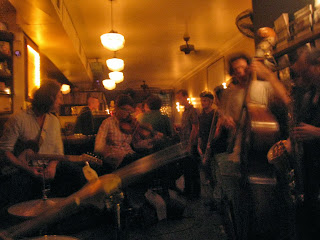
Tender Trap Jam Session
Monday night I joined friends at the Tender Trap jam session in Brooklyn. They're had a regular set followed by a jam session there for some time now. It's a sweet scene - friendly and welcoming. Last time I was in town I wasn't able to play due the problems with my hand/arm so it was nice to get a few tunes in. The only jam session I've attended with four violinists! Take your horn down if you are in the neighborhood or just take your ears and have a beer.

Tuesday morning I joined Will and Carol at B&H to check out some microphones. What a crazy place - I still can't get over that I'd never heard of them. Following that it was off to Carol's for a duo session of standards and free improvisations. It seemed an age since we and played together but things came into place nicely. The free stretches seemed to move into some new places. I must remember to bring my recorder next time I'm in town.
After the session we headed downtown to hear our friend Nick playing a pre-show duo gig at the Signature Theatre. The acoustic was very live (a large space with plenty of concert and wood). Nick's alto sound filled the space and he was barley breathing into the horn. Very relaxed, melodic playing.

Zach Brock Quartet - 55 Bar
I spent Wednesday afternoon out in Newark meeting some of my classmates and sat in on the first of the Duke Ellington classes. I'm sure I'll blog a bit about school in the future.
That evening it was off to Greenwich Village and the 55 Bar for the Zach Brock (violin) Matt Penman (b) John Beasley (fender rhodes) and Obed Calvaire (d). Two sets of mostly Brock originals - plus one from Beasley, Herbie Hancock's "Eye of the Hurricane" and a ballad "You've Changed" (I think). The quartet was tight and bass & drum combo were particularly locked in. Nice catching up with Matt - hadn't seen him since he played in Chicago with the SFJAZZ Collective.

Kept things fairly mellow on Thursday. In the morning I caught up with Richard, a sax playing friend from New Zealand who has just moved to NYC to study towards his Masters Degree. Then it was off out to Brooklyn for a hang, session and lunch with Nick. Hanging and playing with Nick always provide plenty of surprises and laughs. Spent the night with my wonderful hosts - Will & Jennie - dinner and drinks. All in all a fun week - plenty of music and friends - and that's a good thing indeed.

Monday, August 19, 2013

gestalten

Frank Gratkowski Trio Gestalten (JazzHausMusik 1995) Frank Gratkowski (as/b.clar) Dieter Manderscheid (b) Gerry Hamingway (d/perc)
The line up of sax/bass/drums has long been a favorite of mine. Though I am still working my way through his fairly extensive discography (there is still A LOT left to hear) Gestalten is the Gratkowski album I have listened to the most over the years.

"Gesti" 
Leaps from the sax create a “push & pull” type effect. The accompaniment features spacious playing from the bass (in some ways an eco of the sax) and minimal fills from drums. Each players’ part breathes freely, no member encroaches on the other two and everyone sticks to shorter phrase lengths.

"Blazing"  
Alongside the quite busy playing from sax and drums, the Bass is quite a contrast - almost as if he is playing a ballad and the others are up tempo. He utilizes plenty of space. Around the half way mark a slow and dirge-like section appears as the sax wails on top with the drums at his side (urgent but not over powering). The bass remains very much in touch with (not detached from) the trio - very effective. The entire range of the sax comes into play - a distorted bottom end (reverse altissimo?), right through to stratospheric whistles. A short pianissimo burn finishes things off.

"Gloaming" 
A bass feature emerges from the whispers of the trio, working its way to pointed higher register sounds contrasted with bent and sliding notes. The accompaniment - key sounds and air from sax with textural rattles and accents from drums - builds until it becomes a three way dialogue about 2/3rds of the way into the piece. Some great light-toned lines quietly burst free from the sax. The finish is somewhat abrupt. 

"Con Affetto" 
A ballad featuring rich arco tones from the bass and quiet, low register counter lines from the bass clarinet. A nice, economic use of notes for the duration of the piece. Throughout, Hemingway manipulates the pitch of his drums (not a cymbal to be heard) to create a glissandi-like backing. 

"Dancing Derwish”
Urgent bass gets things underway basing his lines on a repeated figure. The intensity gradually rises as the bass clarinet enters alternating clean and distorted sounds, at times very throaty. Manderscheid's fingers really start to fly backed by some great low volume playing from Hemingway (his use of dynamics across the album is impressive). He gets some room to strut his solo playing later in the tune.
Often on this album, the continuity is such that it is difficult to separate the compositional from the improvised sections. For example: following the bass solo when bass clarinet enters, over a solid groove from bass & drums, could easily be composed. 
At 11 and a half minutes this is the longest track on the album. Most sit between four and six minutes with only one other over 10. For those of you that find longer pieces (particularly free improvisations) hard work, take note.

"Stag Rustler" 
A mysterious beginning - at times it's difficult to differentiate between the players parts. Amidst the clicking, clacking, blowing, and occasional low end rumble, a melody makes a brief. The melody retreats and the 'background' intensifies before dropping out altogether and the melody takes us out. Composed by Hemingway

“Ernestine” 
Melodic microtonal playing from sax (at times producing a flute like tone quality). When I tune into the bass & drums low volume backing of the sax, I find them wonderfully in sync. A delicate, haunting ballad.

“Duck Hunt”
A piece of contrasts - starting out quiet(but busy) high register arco bass, light textural percussion and airy, vocalized sounds from sax until 3 and a half mins when alto grunting appears. The saxophone takes on an abrasive, gritty & distorted tone and the notes gather pace. The bass playing becomes more angular, sliding and stark. A wash of sound from the drums covering the whole kit - unrelenting until the seven and a half minute mark when the trio suddenly cuts down to a whisper for the final two minutes - watery breath sounds, stringy bass and scraping drums (at times mimicked by the sax).

"Movements" 
Solitary bass clarinet opens up the piece. The use of dynamics is impressive - from barely audible to loud (not raucous). Scraped cymbals accompany with very occasional arco bass punctuations (he makes each one count). A nice wind down and finish to the album.

General observations:

Form/StructureAs mentioned above it is often difficult to distinguish the improvised from the composed. Form is an important element in Gratkowski's work and here he is playing with artists that can realize improvised structure. The compositions (4 by Gratkowski, 1 by Hemingway & 4 group improvisations) play an important part in the form also - the shape of the album as a whole. Each contain different moods, textures, intensities, tempos, densities and relationships between players.

TextureWhile Gratkowski doesn't expand his arsenal like he does on some albums (no clari/contra bass clari here) he still creates a variety of textures. Playing with clean and distorted tone, mixed articulations, dynamics, air & key sounds, smears, varied tonal color, multiphonics, microtonality etc. 
Plenty of variety from the rhythm section too. The bass uses pizzicato and arco, scratching sounds, percussive playing, string sounds, slides, bends, harmonics, pulse and non-pulse playing. The drums make use of all the sounds available on the kit, varies attack, pulse/non-pulse, rumbles, crashes, rustles, swings,busy at times but rarely overpowers the rest of the trio. 
All three make great use of space and dynamics across the album. 

Unity - A trio of 3 equal parts. As a sax player, my focus is drawn towards the horn. But everyone is on the same wave length and plays a crucial role in shaping each piece.

To my knowledge this trio only made one other album - "The Flume Factor" (I'll add it to my list) - before evolving into a quartet with the addition of Dutch trombonist Wolter Wierbos.