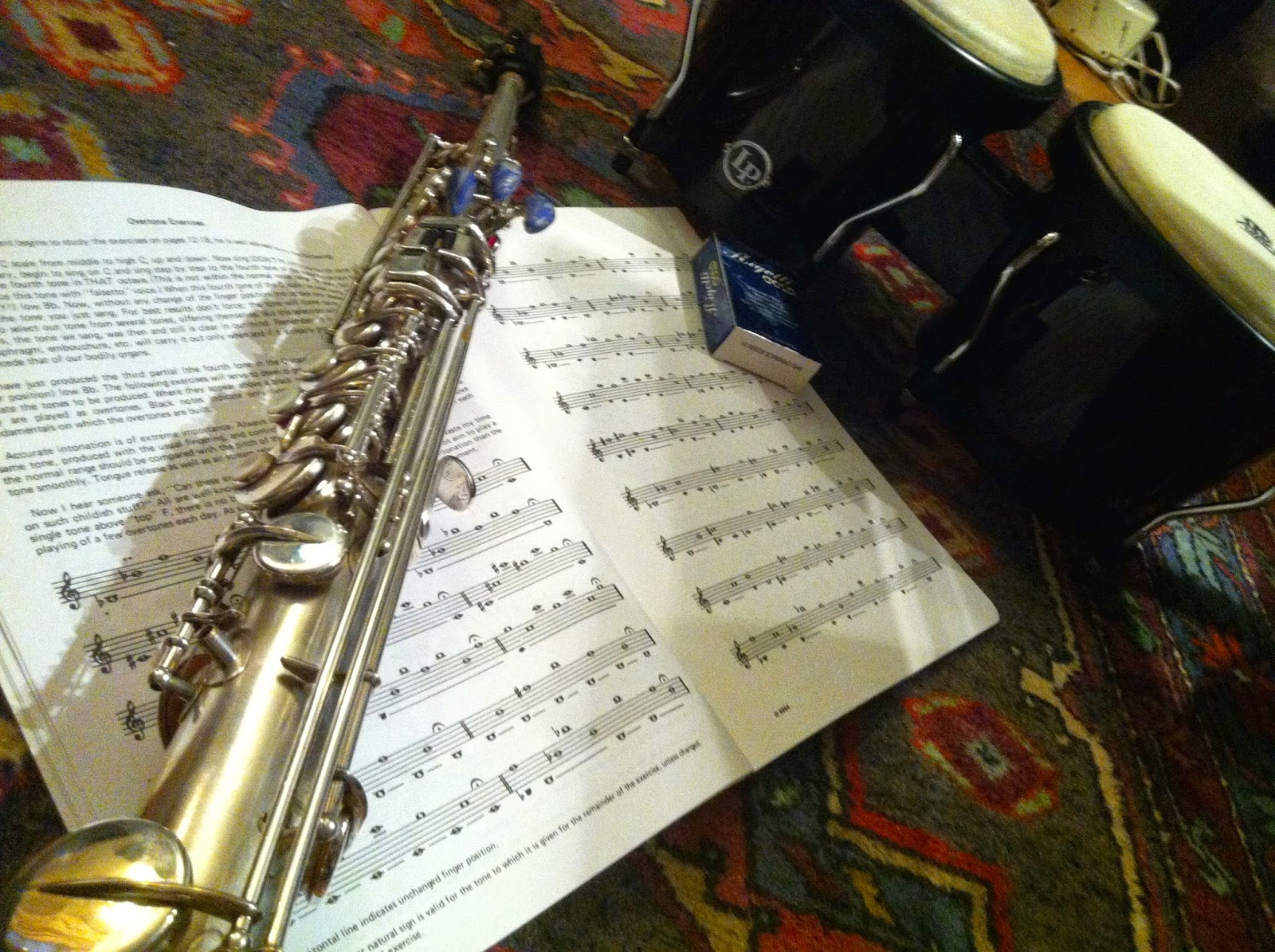
Tuesday, October 14, 2014

Practice Journal: 6 October 2014

Monday:
Modus Vetus - 1 phrase in all keys. I'm sticking with this although today I only had time work on the tonal material.
Overtones and Tone Matching - for me, these always work best once I have played for a little while.

For some reason Bach Invention #2 was on my mind so I tried to play what I could remember. It had been about a year since I last played it and was surprised how much I could remember. Perhaps the Inventions will return to my regular practice.

Those of you that have worked with Jerry Coker's books will recognise a familiar lick in the opening phrase.  I was immediately taken back to Improv classes at university with the class playing licks from Coker's Elements of the Jazz Language along with Band-in-the-Box, a play-a-long album or even a rhythm section. The "3-b9 lick" (see left) was one of those licks. It has been quite some time since I have worked on "material" in that manner. I can't really say I miss it.
===


Tuesday:
Overtones.
Modus Vetus and Modus Novus - singing and playing 1 phrase from each (in all keys).

Rhythm - 2 against 3 and 4 against 3. Swapping between hands and swapping between counting 3 and counting 4.

Bach Invention - worked on it slowly. Breaking down into phrases then linking them together.

Singing with Roy

"September" - Still not really feeling the harmony so this was my focus.
===

Wednesday:
Singing with Glenn Gould playing Bach Invention #2

Long tones on low B and then octaves against pedal tone
Letting It Fall

Modus Vetus - 1 phrase all keys (random)
Modus Novus - 1 phrase all keys (random)

Bach Invention #2
Finished off with some free improvising which ended with a chorus of "My Foolish Heart"
===

Thursday:
Modus Vetus - 1 phrase all keys (minor 3rd apart). I have been playing these in time and, for the most part, quite slowly.

The other day I went to do some work with a tuner but couldn't get it going (and didn't have any spare batteries) so I downloaded this app - Practice + Tuner, Metronome, Recorder and More....

B(s) against pitch generator and tuner (played some other notes against tuner but mostly focussed on B)

Overtones focused on alternating fund a 1st overtone. This is always a bit confusing (fundamental (Bb) 1st (Bb) 2nd (F) or 1st (Bb) 2nd (Bb) 3rd (F) etc. Ive seen it both ways.

Finished off the morning session playing on September (the melody and then a choruses improvising)
===

Friday:
Modus Vetus - one phrase in all keys. This time I tried something a bit different - singing and playing the line against a pedal tone (which acted as the root and also doubled as some tuning work).

Overtones - focused on overtones from B fundamental which was went pretty well today. Then played through some lines in Top Tones.

Bach Invention #2 - pretty much have it memorised just need to smooth things out a bit. Tried it at a few different tempos and then had a crack playing along with Glenn Gould.

Rhythm - tapped out and counted 2 over 3 and 3 over 4 alternating hands and counting while I was waiting for to meet my wife downtown. It's feeling pretty good now so time to move on.
===

Saturday:
Modus Ventus - one phrase in all keys moving by a tritone and minor 2nd (F - B - C - F# - G etc).

Letting It Fall followed by some Overtones and then playing on the mouthpiece.

Modus Novus - one phrase in all keys (moving in the same cycle as above).

Bach Invention #2 - it's feeling better each day I work on it.

"September" - Alternated melody chorus with outlining the harmony. The harmony chorus started off pretty straight (arpeggiating the chords) and then things got a bit more flexible (less set patterns, chromatic passing notes etc).

Rhythm - In between each of the above I worked on a couple of rhythm patterns (see pic). These are from Adam Rudolph's book Pure Rhythm. Earlier in the year I was doing a bit of work with this - day I started getting back into it.
===

Monday, October 13, 2014

Straight Horning: Steve Lacy - Sands

Steve Lacy Sands (Tzadik)
solo saxophone recordingUnaccompanied recordings (this one is from 1998) are a great way to delve into a players sound. Lacy’s tone is complex, rich and full of overtones shaded with varied articulations, vibrato, a growl or two and subtle dynamic shifts. There is a reedy buzz surrounding the note with the breath becoming prominent at times along with the occasional touch of saliva. Nothing is fixed which, in my opinion, is the mark of a great improviser - repeated notes change in colour with every attack, vibrato ebbs and flows etc. On Sands his low register struck me in particular – “fat” doesn’t do it justice. Detail in his tone exists at all dynamic levels, albeit different details (his pianissimo playing great and an area I wish to explore further in my own playing).

The album has one non-solo track – a duo with vocalist Irene Aebi. The two create a remarkable blend (no doubt helped by decades of playing together).

Friday, October 10, 2014

Practice Journal: 29 Sept 2014

I've kept a practice journal periodically ever since I was at university. They come and go and vary in detail.  Last week I started a new one possibly sparked by the arrival on a new soprano (a Buescher True Tone) a week or so before.

It's been fun getting used to the new horn. Overall the ergonomics are not nearly as bad as some would lead you to believe. The transition between low B & C# is taking a bit of getting used as are the different fingerings up top (not front f key). I haven't really looked into the quarter tone fingerings but I know I will need to make some changes as the mechanism is different. I've found that getting the horn well warmed up helps the intonation tendencies to settle down a bit. Here's a rundown of the week.


Monday
Sound:
Terrace Dynamics (a la Sigurd Rascher's Top Tones for Saxophone) on Low E.
Rascher's "Uniformity of Tone Character" - worked between low A and middle F.
Descending octaves without the octave key (aka Letting It Fall) from Low F-Bb
Overtones. Up to third overtone. Including tone matching the regular fingering with 1st, 2nd and 3rd overtones.

Ear Training:
Modus Vetus - taking a line, singing and playing it in all keys (and registers) (round the cycle of 4ths)
Modus Novus - ditto (in whole tones)
I've had these books a little while now but have only just started working with them. Expanding on the work I have done singing/playing interviews and chords.

Tune:
"September In The Rain." This tune popped into my mind one day (perhaps it was raining) so I felt it was a good sign to start working on it.
Looped melody, sang melody, played melody in a few keys. F, C#, G.

Rhythm:
All of these were played on bongos.
Warmed up on a 6/8 rhythms - counting 4/4 and 3/4 against the 6/8 accent.
Revised 3 over 2 and 3 over 4 (and vice versa).
Bell pattern over 4 pulse.
===

Tuesday
Letting It Fall
Overtones and tone matching
G with iTablaPro drone. Terraced dynamics, swells. then G and D (all registers) against drone.
Mouthpiece only - chromatic scale up and down. major scale up and down. Range is about a 10th

Sing with Nate King Cole "Star Dust"
Roy Eldridge "Star Dust" - singing with his solo (at half and full speed).

Modus Vetus - sing and play a phrase in all keys. Used iTabla Pro as a metronome.
Modus Novus - sing and play a phrase in all keys.

"September In The Rain."
Sing with Frank Sinatra
Alternate Playing Melody and sing melody.
Started learning harmony.
===

Wednesday
Rhythm - 6/8 and some 3 over 2.

Dynamics on high G
Tone Uniformity - middle F- high Bb. 
Letting It Fall
Overtones. Lots of tone matching overtone to regular finger (up to 4th overtone)

Modus Vetus 1 phrase round cycle of 4ths
Modus Novus 1 phrase round diminished cycle
September in the Rain melody in keys of E, Eb

Tune - "September In The Rain"
Alternate singing and playing the melody. Root Progression of Harmony. Outlined harmony - no set patterns - some choruses were in time others were rubato. Alternated melody with free improvisation.

Sing - Roy on "Stardust" (1/2 and full speed)
===

Thursday
Started today singing with Roy Eldridge on "Stardust."

Letting It Fall. I find this a nice place to start and find myself returning to it during practice sessions when I want to clear my mind or relax my embouchure.
Bending notes - taking a note and lowering it a semi-tone, whole-tone, minor third, as far as I can go with it. Taken from Steve Lacy's book Findings - I forget what he calls the exercise.
Mouthpiece only.

Rhythm - 6/8 counting 4 and 3.

Modus Vetus - 1 phrase in whole tones.
Modus Novus -1 phrase in min 3rds.

"September" - sing/play melody, outline the harmony. Improvise on the tune to finish things off.
===

Friday
Rhythm - alternating hands between 4 pulse and bell pattern. Worked on this throughout the day in short spells (taking a break from school work, practice break etc).

Warmed up with a couple of minutes freely improvising.

Modus Vetus and Modus Novus - one phrase each in all keys around the cycle of 4ths.

"September" - alternating sing one chorus, play one chorus. This always brings back memories of my lessons with Richard Tabnik.

Singing with Roy's solo on "Stardust." My version seems to be a semi-tone-ish high. I found some versions on youtube that seemed to be at the correct pitch. I may switch over to those versions.
===

Saturday
Warmed up looping the melody of "September." I then returned to work on tune in various ways (melody/singing/Harmony/Improvising) in between my other work.

One phrase from Modus Vetus in all keys moving up in whole tones.
"September"
One phrase from Modus Novus in all keys moving down in whole tones
"September"
Overtones - Once I worked with the first 3 over tones of various fundamentals I focused a little on the top end (4th/5th/6th overtones) off Bb fundamental.
Mouthpiece only.
"September"
Rhythm - bell pattern , alternating hands, various tempos
===

Saturday, October 04, 2014

2014 Blackface Ad from D'Addario Woodwinds

D'Addario Woodwinds (Rico Reeds) posted this "Happy October" message to its Facebook page  yesterday, Oct. 2, 2014.

By the time I took the screenshot and began writing a comment about its blatant racism, the post was removed without acknowledgement or apology from the company that supposedly supports an art and jazz community so deeply rooted in the African-American experience.

**** Updated October 11, 2014****
 On October 7, 2014 I received this email from the social media manager at D'Addario:

I wanted to reach out to you further to our post from the D’Addario Woodwinds Facebook page. First let us apologize for the lack of sensitivity regarding that post. We had brought on a new consultant/intern this past month and had just granted them the ability to post without our micro-managing. It would seem we were premature in that judgment.

I was not in the office when this transpired but it was brought to my attention this morning. I had to dig around to find a few peoples comments and of course, stumbled upon your thoughts as well. Our Woodwinds product team saw the post and took it down as soon as it was observed. We have already spoken to the party involved and are determining how we will proceed.

Please accept our apologies and appreciate that you took the time to voice your opinion on your blog. If we can be of further service, please do not hesitate to contact us.

This morning I replied: 

Thank you for your email. It is reassuring to hear that D’Addario does not consider such a depiction appropriate to share, and unfortunate that your consultant did not recognise the image for what it was. On the other hand perhaps it is indicative of a generation unfamiliar with blackface and racism as a whole in the history of jazz - and your intern may have just thought it was a fun picture of a pumpkin playing a saxophone. Some education may be in order.


Friday, September 26, 2014

Ornette Coleman "Blindfold Test" and "Caught In The Act" Five Spot Review

Here are a few pages from the January 7, 1960 issue of Down Beat Magazine. First up, Ornette Coleman is the subject of Leonard Feather's "Blindfold Test." He comments on the likes of George Russell, Charles Mingus, Quincy Jones, Miles Davis and Yusef Lateef. Then his quartet (with Don Cherry, Charlie Haden and Billy Higgins) is "Caught In The Act" at the Five Spot Cafe by George Hoefer. Enjoy.


Saturday, September 20, 2014

Kenny Wheeler - Angel Song

It was sad news to hear of Kenny Wheeler's passing yesterday. Around 2000, when I was hunting out everything Lee Konitz, I discovered Wheeler's 1996 album Angel Song (ECM). Man, I listened to that album a lot that year or so (and later played "Onmo" in my final recital). It was the Konitz who initially grabbed my attention but I soon discovered that there was a lot more to this album than just his presence. Wheeler, Konitz, Dave Holland and Bill Frisell - four distinctive sounds combing as one made for compelling listening. Spacious, lyrical, wistful and powerful (in ways you don't normally associate that word being used), it seems odd that this was there only album together. My ear is drawn to a horn players tone first and from the start Wheeler had me - personal and expressive combined with lyrical phrasing. His tunes are a key ingredient to the album's overall feel. Listening to Angel Song yesterday afternoon and this morning has made me want to revisit these melodies. Although it had been a couple of years since I last gave it a spin it felt like returning home to old friends. Find some time to relax with this gem of an album.

Friday, September 19, 2014

Straight Horning: Lucky & Zoot

It’s been fun having a re-listen to a couple of albums from players better known for their tenor playing. If you are into the soprano both of these albums are worth a listen.

Lucky Thompson - Lucky Strikes (Prestige, 1964)

My friend Nick emailed me about this album (he has just discovered it) – I hadn’t listened to it for a couple of years and I’d forgotten how sweet Lucky’s soprano tone can be – focused but without too much brightness and with a lightness/fleetness I find attractive and it has made me want to check out more of his soprano work.

Thompson alternates between tenor and soprano sax (4 tunes on each) and the rhythm cooks throughout - as you would expect from Hank Jones (piano) Richard Davis (bass) and Connie Kay (drums). The soprano tunes are: “In A Sentimental Mood” (great ballad sound) and Thomposon’s “Mid-Nite Oil,” “Mumble Neua” and “Prey-Loot.” The stereo separation is pretty heavy with the sax panned well to the left channel – not necessarily a bad if you want to isolate the sax or rhythm section (another good one for this is the album Motion by Lee Konitz).

Don’t discount his tenor playing either. I feel Lucky is a somewhat overlooked/forgotten player.

Zoot Sims Soprano Sax (Pablo, 1976)

There are a few albums from the 70s where Zoot plays soprano on the occasional track or two. Here he’s on soprano throughout along with Ray Bryant (piano) George Mraz (bass) and Grady Tate (drums) in support.

There is an effortlessness and exuberance to Zoot’s playing that I dig – it sounds like he is having fun. The fuzzy tone transfers from his tenor but takes on a bit more edge on the small horn (which is more pronounced when he pushes the volume). He’s melodic and swinging (as always) playing standards and a couple of blues. This time around the ballads “Moonlight In Vermont” and “Ghost Of A Chance” stood out to me – lovely playing.

The bass is a bit rubber band sounding and for my tastes (more noticeable during the solos) and the bowed solo on "Baubles Bangles & Beads" could have been shelved.

Be sure to check out Zoot on alto – very nice too.