Showing posts with label Third Stream. Show all posts

Monday, May 04, 2020

COVID-19 Level 3: Day 4

Bebop Third StreamI forgot to publish this on Friday so I have combined Day 4 and Day 7 (sometimes the days just blend together) – plus what I was working on today didn't lend itself to listening to music.

When I put Perceptions back on the shelf last night I grabbed The Modern Jazz Society Presents A Concert of Contemporary Music. Like Perceptions, is an album purchased during a somewhat brief look at the third stream offerings of the 1950s and 60s – a curious sidebar in jazz. I’ve never been much of a fan of John Lewis. I’m not sure why, but his music has never really grabbed me and as a result I never really explored what he had to offer. I’m open to recommendations though.

I was feeling the need for something a little more high energy – Dizzy Gillespie & Charlie Parker: Town Hall, NYC June 22 1945 – provided just that. Bird sounds so great on this gig, as does Dizzy, and it sounds like they’re having fun. It’s a great archival find, recorded not long after the Guild sessions. And aside from the opening track, “Bebop” (where they’re sorting out the levels), the sound is really good too. The M.C work of Symphony Sid is pretty corny and cringe worthy but it’s great they left him in as it adds to the vibe of the evening. It’s funny how dated the announcements sound but the music remains vital. If you ever needed an example of a drummer dropping bombs, Max Roach’s bass here is loud and clear. It’s also interesting hearing Max and then having Sid Catlett sit in with the same band. Anyway, this is such a great find and we’re lucky to have it so it got another run on Monday morning too.

Thursday, April 30, 2020

COVID-19 Level 3: Day 3


solo jazz saxophoneThe Loft were streaming live from Cologne this morning. Today’s concert was divided into three short sets. First up was the solo alto saxophone of Leonhard Huhn. I have only heard few things online here and there, and he was part of the alto saxophone ensemble for Hayden Chisholm’s album Auto Poetica. I dig his warm sound and melodic approach, even the multiphonic playing retained some of the melodicism. I like to listen to more for him (add it to the list!)

solo jazz saxophoneThe second set was Frank Gratkowski solo. It was a contrast to Huhn set. Starting off quite intense and jagged before moving onto very quiet sounds and then onto short blasts and smears (almost like someone had randomly edited someone playing lines on sax). There’s so much presence in his tone – an edge but still full-toned. Listening to Frank I always wonder how he does it - like when he mixed up playing and singing notes will maintaining the integrity of line. Towards the end of the set I thought he was doing his thing and creating an illusion that the sound was cutting out.... and then he spoke... and the mic was cutting out. The fixed the audio and he finished off with another improvisation. It was a nice contrast between the two solo approaches. Introspected then extroverted.

jazz saxophone duoThen Huhn joined Frank for a duo – the first time they have played in a duo setting. I really enjoyed the blend of two altos. Although their sounds are different they came together nicely. And their individual approaches came together nicely when combined. Frank even played a little bit of sopranino too. And I’m certain the finished on Charlie Haden’s “Silence” (I was working so attention was 100% - sorry guys!). Aside from some technical issues towards the end of Frank’s set, as with yesterday the live sound and production was great .... not sure about the blue/neon though.

Third Stream MusicIt was a day of contrasts, as after the headphones came off, Dizzy Gillespie’s Perceptions came on (by the time I set up the computer speakers I won’t be working from home any more!). I picked this up a few years ago when I was checking out some ‘third stream’ recordings. Recorded in 1961, Dizzy is the featured soloist playing six pieces by J.J. Johnson for brass orchestra and rhythm section (21 pieces plus Dizzy). I’ll have to bust out the liner notes to see if it mentions how this session came about as it’s a really interesting recording showcasing a different side of Diz . I’d be curious to read some reviews of the album from back in the day to see what was thought about it at the time. Perceptions could be the ticket if you fancy something a bit different from his ‘usual’ output.

Thursday, December 01, 2016

Lambic Jazz Vol.10


With Thanksgiving done and dusted classes resume as does the 10th edition of Lambic Jazz. I have a number of recordings of Third Stream - that curios blend of jazz and classical - it manages to draw me in even though not much of it really appeals to me. So following a short practice, here I am relaxing after class with a glass of Boon Ode Geuze while listening to The Modern Jazz Society Presents a Concert of Contemporary Music (Verve).

Lambic beer Chord Scale Theory
The recording dates from March 14, 1955 and of the six pieces, J.J Johnson’s “Turnpike” (which is a rehearsal take only) is the lone composition not from the pen of John Lewis with the arranging duties split between Gunther Schuller and Lewis for the remaining pieces. 

The ensemble size varies from 9-10 players consisting of J.J. Johnson (trb) Gunther Schuller (f.horn/arranger) James Politis (f) Aaron Sachs/Tony Scott (cl) Lucky Thompson/Stan Getz (ts) Manuel Zegler (bassoon) Janet Putnam (harp) John Lewis (p/arranger) Percy Heath (b) Connie Kay (d) with Thompson, Getz, Scott, Sachs and Johnson being the featured soloists. I was pleasantly surprised how nicely Lucky Thompson's tenor playing slotted in to the overall sound. 

Although I have enjoyed listening to this album this week (and tonight), it's not really my cup of tea. Overall it's a pretty mellow album and perhaps at times it's a little samey mood wise, but I wouldn't hesitate recommending it to fans of John Lewis, Gunther Schuller or the Third Stream. 

"Turnpike" (a variation on Monk's "Thelonious"?) gets things moving along. Strangely, the false start take of this song kicks off on the same track as the preceding "Sun Dance." That's not the only oddity. The original notes from John Lewis are printed on the back cover and the booklet contains notes from Gunther Schuller. However, Schuller's notes suffer from some poor copy editing - how didn't they notice that the middle third of the notes are missing only to have the first page repeated?!

While we're on the subjects of edits..... courtesy of a free subscription, a copy of Jazziz arrived in the mail yesterday. It's the first copy I have picked up in ages. Someone managed to miss that the Donny McCaslin article had a page missing.....oops. While it's pretty mainstream stuff it was refreshing to flick through a jazz magazine and not be bombarded with jazz education related articles and advertising.

And while we are on that subject...... jazz education, in a similar way to third stream music, also draws me in. Not because I'm sold by what it has become (far from it) but because I'm curious to find out what people have to say on the topic. I was exposed to the "chord scale" method during my undergraduate studies (actually, now that I think about things, it would have been slightly prior to that via some Aebersold play-alongs) and it never really agreed with me. The pervasiveness of the "chord scale" method in education is unsurprising due to it's black and white nature. And while I don't subscribe to it as a method for improvising, I picked up these two books - The Chord Scale Method & Jazz Harmony by Barrie Nettles and Richard Graf (Advance Music) and The Berklee Book of Jazz Harmony by Joe Mulholland and Tom Hojnacki (Berklee Press) - for some light entertainment and comparison. So far the newer of the two (the Berklee publication) seems a little more direct and to the point but I'm only about 20 pages into each - lets see if I can stick with them.

Thursday, October 08, 2015

Recent Listening: Late Sept-Early Oct

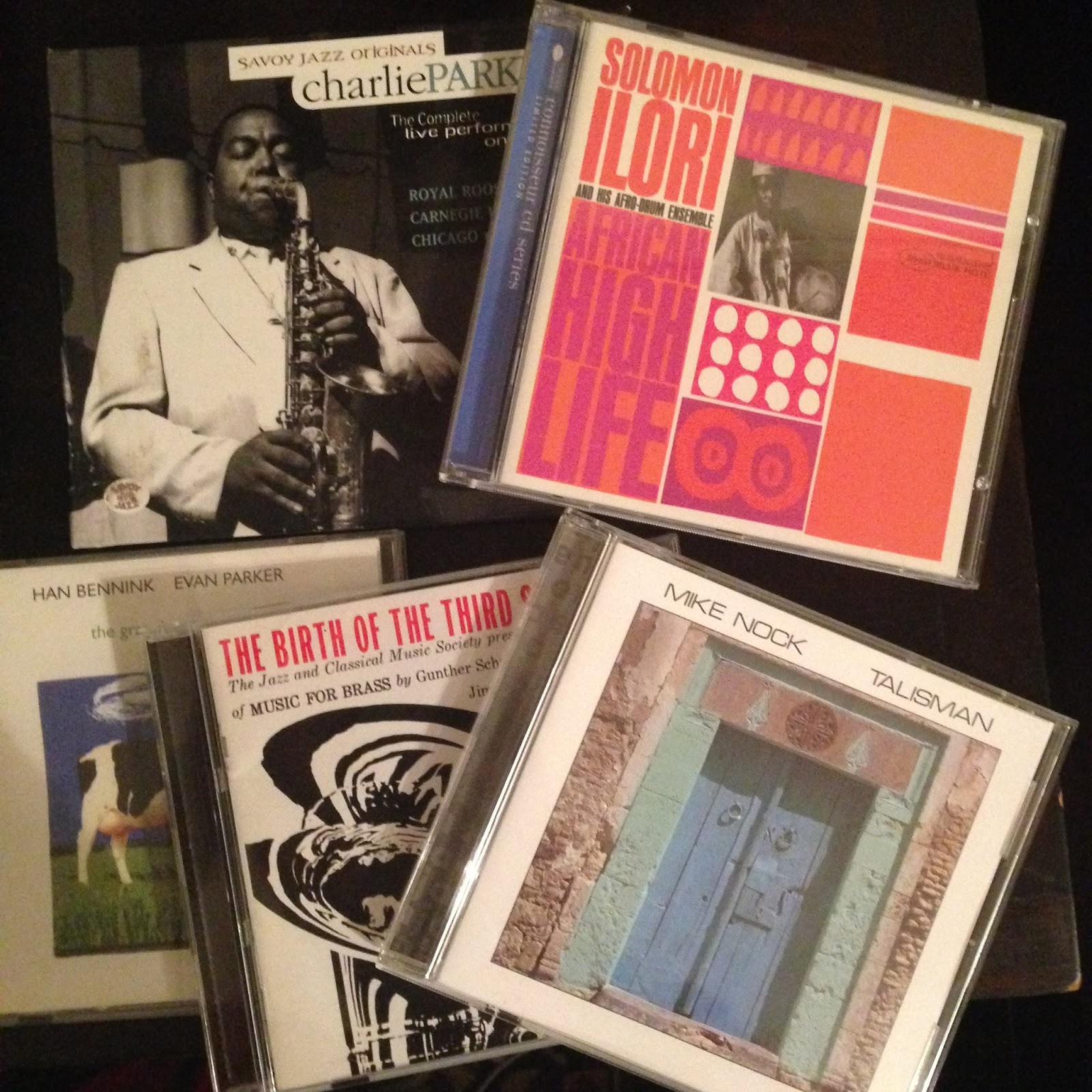
Solomon Ilori and his Afro-Drum Ensemble: African High Life (Blue Note). I was on the lookout for Art Blakey's The African Beat when I came across this recording from 1964.

Evan Parker & Han Bennink: The Grass Is Greener (PSI). Although this album has its moments, I haven't really been able to get into it just yet. That won't stop me to returning to it though.

Charlie Parker: The Complete Live Performances on Savoy (Savoy). Mostly I've been listening to the 1947 Carnegie Hall tracks with Dizzy, John Lewis (pretty well off-mic), Al McKibbon and Joe Harris. Bird's tone is nicely captured, and Dizzy has plenty of fire. Bird's break on "Groovin' High" always gives me a kick.

Mike Nock: Talisman (Enja). A lovely late-70s solo piano outing from Nock that I picked up earlier this year. This one was accompanying me as I waited to get a couple of Mike's more recent albums (more on them to come later).

Various: The Birth of the Third Stream (Columbia). This one had been on my list for a while and I've been playing tracks from it over the last few weeks (in fact, it's playing as I write this post). It's a little annoying that they weren't able to squeeze two of the tracks from Music for Brass onto the CD. Worth checking out if you haven't (particularly for arrangers/composers).

Tuesday, April 21, 2015

Ran Blake's Third Stream - Down Beat 1980

Today is Ran Blake's 80th birthday (b. April 20, 1935). As I mentioned earlier this month, The Newest Sound Around has been getting some airplay of late. I'm looking forward to hearing his latest album - Ghost Tones: A Tribute To George Russell. But for now, I'm reading Art Lange's feature article on Blake from the February 1980 issue of Down Beat.
Click on the image to view PDF of the full article. More vintage magazine articles can be found here.

Down Beat February 1980 Art Lange

Wednesday, July 30, 2014

a couple of discs from the nyc trip

Last week I was in New York City and, as I usually try to do, I stopped by the Jazz Record Center and Downtown Music Gallery - I managed to behave, limiting myself to one album from each store. All jazz fans who make it to NYC need add these two stores to their schedules.

The Jimmy Giuffre 3 & 4: New York Concerts (Elemental Records)
The two concerts were recorded during 1965 for broadcast of on WKCR-FM, the tapes recently came to light and were released earlier this year filling a spot in the decade-long gap in Giuffre's discography following the release of Free Fall.
The first disc features the trio of Jimmy Giuffre (clarinet & tenor sax) Richard Davis (bass) and Joe Chambers (drums) and opens with Giuffre on Tenor sax. The tone is robust and not what many would associate with Giuffre if they have only heard the airy whispers his earlier work (although there are recordings from 1952 with Howard Rumsey where he honks, growls and wails).

Fans of Ornette Coleman will be interested to hear the trio's sparse and slower take on Coleman's "Crossroads" with Giuffre on clarinet.

It's great hearing Giuffre playing this music with drums. Chambers fits in well and uses space nicely, mixing up broken time, color/texture playing and time. Check out drive "Drive" where his playing flows between approaches very smoothly. Davis sounds great here too (duo spots with Giuffre and solo playing) - the excellent recording quality is a bonus too. It's an interesting piece that mixes up fairly introspective sections with more full throttle playing. At 11 minutes it's the longest track on the disc and the trio keep it interesting throughout.

The last two pieces - "Quadrangles" and "Angles" - contrast one another. The former being a quieter piece with Giuffre on clarinet, the later a kicking off with some powerful tenor playing moving into a section with Giuffre playing high, single note attacks before taking the tune out.

The second disc is from a concert from earlier in 1965 featuring the quartet of Jimmy Giuffre (clarinet & tenor sax) Don Friedman (piano) Barre Phillips (bass) and Joe Chambers (drums). The two concerts have four tunes in common and a more listenings will be required before I draw to many comparisons. On the surface the obvious change is the fuller sound of the ensemble due to the addition of piano. Even so, the change is not as dramatic as I expected. There is still plenty of space and density/texture seems to be a detail Giuffre paid plenty of attention to. On many occasions only two or three of the quartet are playing. When all four are present often a couple of them are keeping their roles to interjections and responses. Players entering and dropping out (seemingly at will) caught my ear and I found it compelling listening.

The recording quality is very nice and it's a nice package too - 27 pages of photographs and notes from Zev Feldman (Producer) Philippe Carles (author) Bob Blumenthal (critic) George Klabin (Recording engineer) Juanita Giuffre (Jimmy's Wife) Paul Bley (an except from his book Stopping Time) Jim Hall and Steve Swallow. A must for fans of Giuffre. I've added this to the my "best of 2014" list.

John Zorn Stephen Gosling
Stephen Gosling Trio: John Zorn's In The Hall Of Mirrors (Tzadik)
I recently heard Gosling playing "Illuminations" on Zorn's Rimbaud and a quick search brought up this recently released album (recorded in February, 2014). For this album (like on "Illuminations"), Stephen Gosling performs works by composed by John Zorn (yes, the piano pieces are 100% notated) with improvised accompaniment from Greg Cohen (bass) Tyshawn Sorey (drums)

I'm curios about the preparation of the rhythm section. Did they have scores or had they heard the pieces before the recording? If the answer is no, then their playing is all the more remarkable. There is a high level of communication between the bass and drums as a pair and in combination with the piano.

The six compositions span from 2010 - 2014 and there is plenty of variety - from the mellow opening "Epode" to the rumbling intensity of "Maldoror" and power of "Illuminations" to the balladry of "In Lovely Blueness" to the minimal and abstract "Nightwood."

A small complaint - I understand the visual confusion of being in a hall of mirrors but did that require them to make the liner notes so difficult to read?

It's a recording that blurs the lines…. classical…. jazz ….. third stream….. other? Worth while checking out for those interesting in piano trios, new music or something a bit different. A fantastic candidate for a blindfold test!

Wednesday, June 11, 2014

Lee Konitz: An Image

Lee Konitz with Strings: An Image (reissued on Lee Konitz Meets Jimmy Giuffre)

Last semester I took a class about “West Coast/Cool/Third Stream.“ The class led me to revisit this album recorded back in 1958. Although there are a few standards (“Round Midnight,” “I Got It Bad” and “What’s New”) on the album they don’t fall into the cheesy “jazz with strings” category, there is the three-part “Music For Alto Saxophone and Strings” (this does incorporate the rhythm section) and the seven-part “An Image Of Man” (just Konitz and strings – including Billy Bauer). The album has quite a sparse feel, openness to it... uncluttered. Bill Russo’s writing throughout keeps things interesting and Lee sounds great on it - I’d forgotten how great... very lyrical and the recording captures his tone wonderfully. The Russo/Konitz combination is a good one  - they both have plenty of common ground. Aside from both being students of Tristano, when the two were with Kenton they used to hang out listening to string quartets from Bartok, Debussy and Ravel. This album made a big impact on me when I first heard it (around 1999/2000) – it had been ages since I listened to it and I’m glad I got back into it.

While I’m on the subject of Konitz, a few of his album featured in the “The Top 50 Alto Sax Recordings of All Time” from Jazz Times (June) with Motion, Live at The Half Note, Subconscious-Lee making the list. Konitz was also singled out by Phil Woods (Jazz Nocturne), Jaleel Shaw & Miguel Zenon (Motion), Grace Kelly (Live at Half Note) and JayBeckenstein (The Lee Konitz Duets) in their lists of favourite alto sax albums.

There was no place for Konitz in Down Beat’s “80 Coolest Things In Jazz Today”... not even in the “Living Masters” category.