Showing posts with label Evan Parker. Show all posts

Thursday, April 25, 2019

Music for Commuting: Trio = Piano + Sax + Bass

Slow FoxThe commuting continues but the posts have slowed down. Long weekend procrastination was not particularly obliging with blog updates but a couple of train rides helped scraping together something. I’m slowly catching up on things.

I played the title track from Time Will Tell to some friends earlier in the month. I’m not sure it really resonated with them, but that won’t stop me from trying to expose them to some different stuff. The follow-up, Sankt Gerold, is on my “to get” list. I'm pretty keen to hear Barre Phillips new solo album too.

I hadn’t listened to Slow Fox’s second album, Gentle Giants, all that much and I was happy reacquainting myself it on the way to work last week. It led me back to the trio’s first album, The Wood, when heading into Wellington for a couple of gigs. I was going to try and play favorites, but in the end.... why bother when you can sit back and enjoy them both. For NZ Music Month I’ll be sending a bunch of friends a playlist which will include a track from Gentle Giants.


Monday, August 21, 2017

Straight Horning: Evan Parker & Spontaneous Music Ensemble

Spontaneous Music Ensemble: Summer 1967 (Emanem)

I’ve been meaning to write about this album for a while now. Some months ago I wrote some notes but who knows where they ended up, so I’m starting from scratch today.
Pipeworks Dame Errant

Some of you may know I’m a fan of checking out early recordings by players who interest me. There are earlier recordings of Parker on Withdrawal, but on those recordings he has a pretty minor role in proceedings. Summer 1967 is a different story, as here he shares the front line with drummer John Stevens (drums/perc) and bassist Peter Kowald (on the two longer tracks). Even at this early stage it sounds like Evan Parker to me. The tone is not as full (the fidelity of the recording may not help) and there is not much in the way extended techniques but the playing still points to Evan Parker. I think it’s the series of short bursts and a staccato/jagged approach to his phrasing

The album comes from three separate sessions in August and September 1967:
- 5 improvised duets (4 on soprano and 1 tenor) that are, at times, quite minimal and in which space is well utilized.
- 2 longer improvised trio pieces (1 each on soprano and tenor) Clocking in at 14 and 11 minutes, I liked the pacing of these longer works - the phrases have space to breathe.
- 3 improvised duets (all soprano) the title “Echo Chamber Music” is apt and the echo on the recording adds a bit of fullness to the sax sound (but it’s still a bit over the top). These don’t seem as jagged as the first 5 duets (but maybe it’s just the echo mellowing things out a little).

Even as the density rises the music tends to stay on the quiet side (reflecting John Stevens’ ethos at the time), and I find this quiet intensity appealing. At times the music is quietly urgent and off the top of my head I can’t think of many similar examples that come to mind. In some ways there is bit of sameness throughout each of the three sessions, but I actually don’t mind it all that much.

This is Evan Parker's first major statement on record, and as such, if you're a fan of his work you'll want to pick this up.

For those interested in the pint…. it’s Dame Errant from Pipeworks, an English style IPA that had bit of a shake up on the way home but still tasted good.

Thursday, April 06, 2017

Saturday, February 11, 2017

Spontaneous Music Ensemble: Challenge

Spontaneous Music Ensemble: Challenge (Emanem)

Having heard a smattering of their recordings, I’m finally getting around to listening to Spontaneous Music Ensemble a bit more carefully. I figured starting at the beginning is probably a sound move. Challenge, recorded in March 1966, is a fascinating album as it captures SME in its formative stages. In fact, had this been a blindfold test I may not have been able to pin point it.

John Stevens Trevor Watts Evan Parker Kenny Wheeler
This incarnation of SME features Kenny Wheeler (trpt) Paul Rutherford (trb) Trevor Watts (as/ss) John Stevens (d) and Bruce Cale and Jeff Clyne (splitting the bass duties).

There are moments that hint at the freer approach that was to come (the collective playing on “End to a Beginning”) but for me the music still fits comfortably into the “Free Jazz” mode with composed pieces by Watts, Rutherford and Stevens, soloists with accompaniment, some collective improvising and a rhythm section swinging - nothing particularly unconventional for the time. And that’s not a criticism, the music remains engaging throughout and I feel they create a solid ensemble sound. It’s thoughtful and dynamic music. 

“E.D’s Message” opens the album and it doesn’t hold back with plenty of high-energy output from Trevor Watts - perhaps the boldest solo voice on the album, although Rutherford has some nice moments too such as on “After Listening.” The rhythm section comfortably moves between time and a more textural approach. At times things get pretty busy but Stevens sounds assured throughout and is a very responsive accompanist. There are a few nice arco spots from Cale too. It’s funny how something pricks up your ears. For me, it was Stevens’ cymbal work on “Travelling Together” - a whispering shimmer that moves to a bell pattern just as the piece seemly comes to an end before the drum solo takes flight. Wheeler still seems to be finding his feet in this setting and is somewhat more tentative than the others with maybe just the occasional hint at his mature style. He gets a bit of room to move on “After Listening,” which features solos from the each of the horns. A standout from this track is the superb accompaniment of Stevens and Cale. They manage to lock in with each soloist, creating music informed by the soloist rather than relying on rote accompaniment.

There is something familiar about some of the pieces and I struggled to put my finger on what it was. As I continued to listen throughout the week I was reminded, on more than one occasion, of the Bobby Bradford/John Carter Quartet. I guess there are some similarities…. bass and drums with horns (in this case three rather than two) and a post-Ornette vibe that is present at times - but I’m still not sure that’s what it is. [Side Note: I’m not overly familiar with the Bradford/Carter group, eventually I might get to a more in depth listen to them as well.]

For the final track on the disc, Chris Cambridge (b) and Evan Parker (ss) join John Stevens and Trevor Watts. Recorded in April, 1967, “Distant Little Soul,” is moving towards what I hear in my mind’s ear when I think of SME - exploratory (rather than experimental) group improvisation at the quieter end of the spectrum.   

So far, this is the earliest recording of Parker’s I have heard and the distinctive voice he developed is still in its infancy. It’s fascinating hearing players early in their career (Bird with Jay McShann, Lee Konitz with Claude Thornhill etc.) so for fans of Evan Parker this track is worth the price of admission. Withdrawn contains some Parker from around the same time… I’ll be getting to that album next.

Thursday, December 22, 2016

Straight Horning - Evan Parker: As the Wind

In addition to his solo saxophone recordings, I'm a fan of Evan Parker's quieter outings such as his duo with Richard Nuns, Rangirua, and the two trio albums with Paul Bley and Barre Phillips, Time Will Tell and Sankt Gerold Variations. The recently released As the Wind, fits the bill nicely and has been getting a fair bit of airtime. [As an aside: I have never been able to get into his work with long-time collaborators Barry Guy and Paul Lytton or as part of Alexander von Schlippenbach's trio].
Toma Gouband Mark Nauseef
Evan ParkerAs the Wind (PSI Records)

I'm very happy to have stumbled upon this while browsing the shelves at Dusty Groove. It was the line-up that raised my curiosity levels -  Parker sticks to the soprano throughout nine free improvisations with Toma Gouband (Lithophones) and Mark Nauseef (Percussion). 

The music is never too busy with space playing an important role in the album. It is music that is not in a rush and has an open and airy presence. Flurries of notes punctuate periods of sustained sounds. Surges of sound retreat as quickly as they appear. At times I couldn't help but think of Gagaku or the Shakuhachi. It's a marvelous feeling to be immersed in a recording to the point, no longer aware of the specific instruments being played, you just bask in the sound.

The air sounds, microtones and multiphonics are not just played for show and flash. And lets not forget clean notes... Parker has a great clean soprano tone but it's something that is not often mentioned. I'm really enjoying the sound of this album. Not only does it showcase the many subtleties of the individuals but also the wonderful blend of the trio is beautifully captured. 

I don't get the feeling the trio is trying to do something new. In fact, it feels like they tap into something quite ancient, perhaps even primitive. I can’t quite put my finger on what it is, but it makes for compelling listening as another year rolls around.

Wednesday, December 14, 2016

cough cough

The last couple of days have been spent recovering from a cold/bug/whatever. While it's not the best timing (I have a busy week planned), it has given me the chance to listen to some music.

After trying (and failing) to work my way through the 2-disc sampler, "Critic's Choices & Other Voices," that came with Jazziz magazine, I listened to a selection of artists from the 1920s and 30s - Jabbo Smith, Tiny Parham, Mills Blue Rhythm Band, Lovie Austin, Mezz Mezzrow, Eddie South and Jimmy Lunceford among others. I've just wrapped up reading Allen Lowe's That Devilin' Tune which no doubt helped nudge me to revisit the 1920s and 30s. As I've made my way through the book I've been listening to some of the tracks mentioned and on Monday I created a few random playlists and hit play. A few years ago I spent a lot of time listening to jazz from the first 20 years of its recorded history but since then it has been a sporadic effort at best and it made for a refreshing change.

And while the 20s and 30s are on my mind....Charley Patton also has been getting some airtime. I picked up a 3-disc set a short while ago and I'm finally getting around to giving it a listen. The focus was on the first disc but I will make sure I get to the other two before the year is out. There will more acoustic blues added to my listening in the near future. Patton made a nice contrast to Evan Parker's As the Wind (which I'll write more on that later but I'm liking what I hear so far).

Christian Weidner's Every Hour of the Light and Dark arrived in the mail yesterday so I gave it a cursory listen this morning and again this afternoon. I'm not sure if brooding is an apt description, reflective maybe, but not overly introspective.

No blowing the horn, but I have been tapping out of various 8th notes and triplets groupings from Ed Saindon's Exploration in Rhythm. 

Thursday, October 08, 2015

Recent Listening: Late Sept-Early Oct

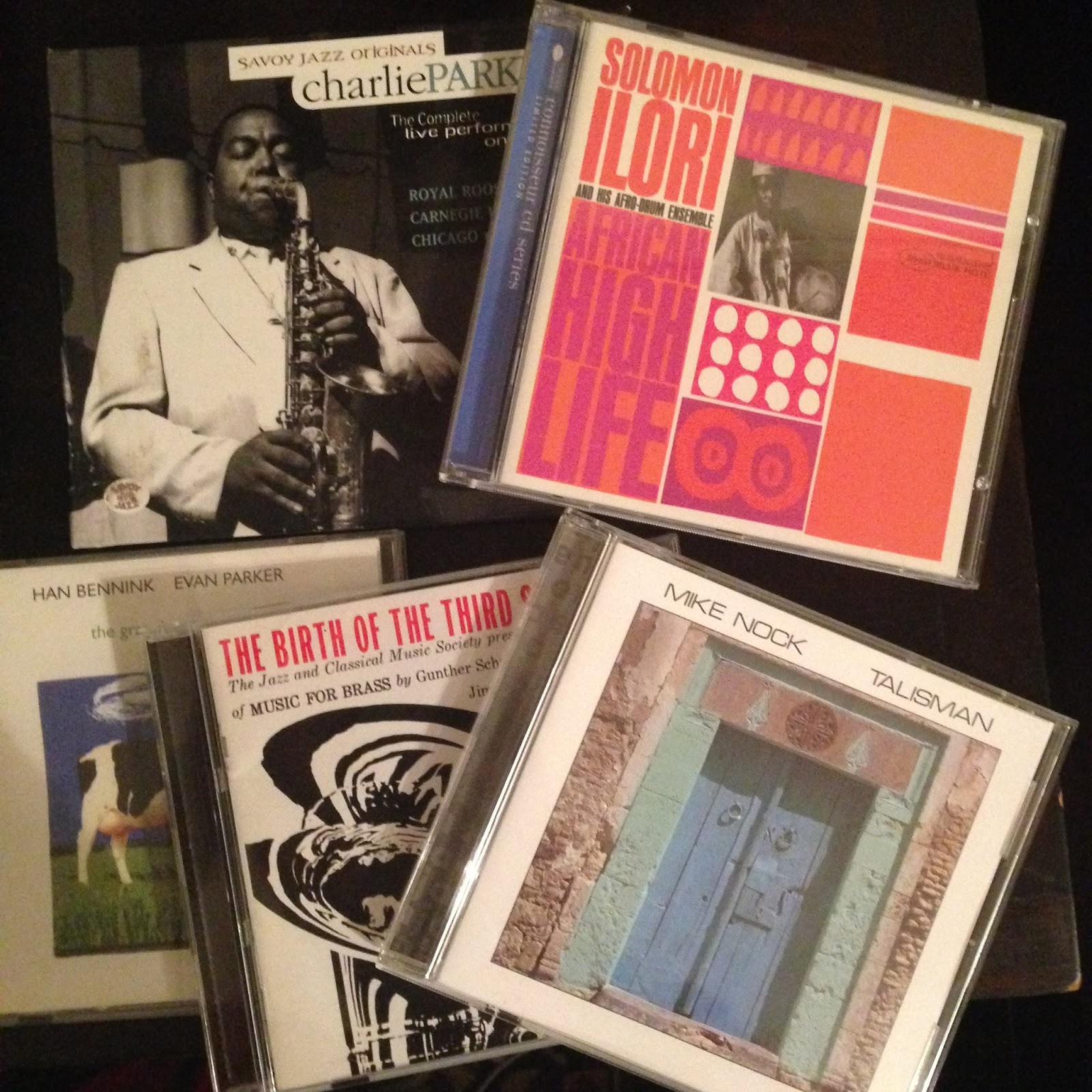
Solomon Ilori and his Afro-Drum Ensemble: African High Life (Blue Note). I was on the lookout for Art Blakey's The African Beat when I came across this recording from 1964.

Evan Parker & Han Bennink: The Grass Is Greener (PSI). Although this album has its moments, I haven't really been able to get into it just yet. That won't stop me to returning to it though.

Charlie Parker: The Complete Live Performances on Savoy (Savoy). Mostly I've been listening to the 1947 Carnegie Hall tracks with Dizzy, John Lewis (pretty well off-mic), Al McKibbon and Joe Harris. Bird's tone is nicely captured, and Dizzy has plenty of fire. Bird's break on "Groovin' High" always gives me a kick.

Mike Nock: Talisman (Enja). A lovely late-70s solo piano outing from Nock that I picked up earlier this year. This one was accompanying me as I waited to get a couple of Mike's more recent albums (more on them to come later).

Various: The Birth of the Third Stream (Columbia). This one had been on my list for a while and I've been playing tracks from it over the last few weeks (in fact, it's playing as I write this post). It's a little annoying that they weren't able to squeeze two of the tracks from Music for Brass onto the CD. Worth checking out if you haven't (particularly for arrangers/composers).

Sunday, August 03, 2014

Straight Horning: Time Lapse/Follies/Chirps

Evan Parker Time Lapse (Tzadik)

Recorded in various sessions between 1996 and 2001 this solo album mixes up solo pieces with overdubbed solo works. Parker sticks to soprano throughout (aside from “Organ Point” where he plays organ in addition to soprano). Check out the strong melodies he blows over the hypnotic backing on “Ak-Kor-Deer” (great, clean tone here too). “Pulse and the Circulation of the Blood” features more hypnotic soprano’s circling around each other. “Chorus After Alaric 1 or 2 for Gavin Byers” has an eerie, lyrical, unrushed quality to it that appeals to me. The three solo pieces are more in line with Parker’s previous solo soprano recordings. The more I listen to Parker the more I dig is sound. When Parker holds notes/plays clean his tone really comes to the fore – something that doesn’t always show through on his solo outings.

Steve Lacy Quintet Follies (FMP)

Steve Potts (alto sax) Irene Aebi (cello) Kent Carter (b) Oliver Johnson (d) I picked this up from the Destination Out store. It’s pretty raw live recording (Berlin 1977) and that rawness matches the intensity of the music. It’s an intense album and recommended for those looking for some full-throttle Lacy (check out his burning solos on “The Crust” or the title track. The band is breathing fire with the two saxophones blowing on top. Aebi’s cello adds to the vibe, it has a dark mysterious quality to it – this album would sound very different without it (or if it had been replaced with, say, piano). Potts has a distinctive voice on alto for which I feel he gets very little acknowledgement. Lacy really took the horn places… not just soprano, but the saxophone in general and the music too.

Steve Lacy & Evan Parker Chirps (FMP)

Another disc I picked up at the Destination Out store. The first three tracks are from a Berlin concert in 1985 and the remaining three tracks were recorded at the same venue following the concert. The two soprano masters are well attuned to one another and have a great blend (tone/sounds and musically). It’s nice to hear the Lacy influence on Parker’s playing. He plays differently here - I was (pleasantly) surprised to hear just how much Parker moved towards Lacy during this disc. This is a very listenable set and one that I’m sure to return to again and again. Soprano players put this on your required listening, and anyone interested in duo performances will take plenty away from this album. It’s a very nice sounding recording too.

Saturday, June 07, 2014

Workshops and Masterclasses

I came across a list of workshops and masterclass I have attended over the years. Most of these took place at NZSM. It is not a complete list but I decided to add a few brief notes from what I can remember from them.

Evan Parker Steve Lacy
These two were separately involved in the 1999 Wellington Jazz Festival (the masterclasses were at The Space). At the time I knew very little of both artists (I had heard a couple of recordings of Lacy (Reflections and Evidence from memory) and something by Parker) and at first was a little disappointed neither played but soon found what they had to say was very interesting - I have no idea if these sessions were recorded but I would love to hear what they had to say now that I'm more familiar with their work. I enjoyed their concerts too - Parker's second set (a duo with Richard Nunns) was later released on Leo Records.

Mike Nock - I wrote a little on this one here.

Bernie McGann Trio (2000) He spoke very highly of Art Pepper (particularly the album Meets The Rhythm Section) but I don't remember much else from this session. The trio played a tune or two and there was some Q&A.

Frank Gratkowski (August 2009)When I attended music village an added bonus was the presence of Frank Gratkowski. One afternoon Hayden Chisholm handed the baton to Frank for a session. Frank spoke of his experiences in music, aesthetics, music he listens too, work he has done, played recordings etc - fascinating stuff. Here’s a short feature on Frank that Hayden produced & filmed in the village square of Agios Lavrentios.

The Thing (Mats Gustaffson, Paal Nilson-Love, Ingebrigt Haker Flaten) This one was hands-on practical and very inclusive. The trio had everyone up playing as part of an improvising ensemble. We moved around the circle playing solo improvisations, duos, trios and eventually everyone all in. The emphasis was on making music. A fun session.

Root 70 (Nils Wogram, Hayden Chisholm, Matt Penman, Jochen Rueckert)(2007) Another very hands-on session. There was an emphasis developing a balanced ensemble sound (something Root 70 definitely achieve). At one stage there were about eight horns playing background riffs behind a bass solo (on a blues). The message - if you cannot hear the bass you're playing too loud. We also had a crack at playing trades on one of Root 70's odd-meter tunes. Hayden invited 5 or 6 sax players to get together before the sound check the following day for an extra session. Here he introduced ideas that I would explore further during his annual workshop in Greece.

Steve Coleman (circa Sept 2009) This was part of Coleman's ongoing series in NYC at the Jazz Gallery. Not surprisingly rhythm was at the fore - lots of clapping. A few people played - trumpeter Jonathan Finlayson, a pianist and a guitarist. Coleman played a rhythmically altered “All The Things You Are” unaccompanied and sounded very nice. It was an interesting session but I felt well out of my depth! These sessions are well worth attending but only going to one (as I did) is probably not recommended. 

Dave Douglas (2002) Talked about busking on the streets of NYC and a little about his time with Horace Silver. Silver stressed to him the importance of voice leading, which Douglas demonstrated playing over a II-V-I progression, gradually adding to the complexity of the line while retaining the same 7-3 voice leading between chords. Another topic covered was using a metronome. He demonstrated by playing “All The Things You Are” with the metronome clicking in different places, such as every 5th beat and on up-beats.

Adam Simmons(circa 2003) One of the only things I remember from this was him singing the praises of Rahsaan Roland Kirk.

Vinny Golia - On the subject of his large ensemble, I remember him saying that many of the members were involved in contemporary classical/new music fields and he felt they were better suited to the demands of the written music as well as improvising in his large ensemble. And that many jazz players were boxed-in stylistically and it didn't fit with the group.
He told a great story from when he was into the music but not yet playing (he was a visual artist before becoming a musician and some of his work was featured on album covers - Dave Holland/Barre Phillips Music from Two Basses for example). One day he was walking (somewhere in NYC) when he heard a saxophonist practicing. Liking what he heard, he stood outside the apartment and listened to them going about there work. After awhile, the music stopped and out walked Archie Shepp. He came straight over to Golia and asked “Are you a saxophone player?” (Thinking Vinny was outside trying to steal his chops!), Golia replied “No, I’m a painter,” and Shepp was cool with that.
I must admit, there have been a couple of times when I've been walking around the city and stopped outside an apartment to listen to someone practicing.

Jon Gordon - I don’t remember much from the masterclass itself (scales in all intervals, II-V’s). However, following the masterclass I spoke with a few of the sax students at NZSM. The previous day they had private lessons with him and he had covered the same stuff in both - they were not impressed. Lesson learned - try and get your lesson with a visiting artist after the masterclass!

Gordon Brisker came through school twice a few years apart (early 2000s). Each time he handed out and ran through the same handout. I keep it but it is back in NZ - from memory it included some sound work, a scale routine and II-V-I licks.


Mike Brignola - Usually I try and take something positive away from masterclasses etc. In this case it was very hard to do. If there was one, it was that he mentioned/demonstrated overtones. The session ended with people sight-reading saxophone quartet charts. It didn’t seem as though there was much preparation.

Bob Mintzer - I've been to a couple from Mintzer (both in the late 2000s)
Composition/Arranging - he put across a simple message. When he was young, there was very little in the way on books etc. Play something and if you like it, write in down. If you don't like it, change it. That, and ask people questions - he said they (jazz greats and more experienced players) never really answered the question he asked but he learned something regardless.

Saxophone - making up your own little melodic ideas and playing them through all keys. It could be based on something you have transcribed or adapted from a classical étude - he recommended Eugene Bozza “Caprices” and Sigfrid Karg-Elert studies. He demonstrated something he took and adapted from Michael Brecker There's an article on his blog that deals with the subject. A more detailed article is online somewhere but after a quick search I couldn't find it - it could have be in JazzEd Magazine.

Pat Crumly (2001) He was leading the Ronnie Scott legacy band tour of New Zealand. Aside from him recommending you fry your spices when making a curry(!) I don't really remember the workshop. The first notes he played as a warm up for the concert was the "CMAR lick." This was a lick we had to learn for our improvisation class (along with a bunch of other stuff from Jerry Coker's Elements of Jazz). I was sitting with a few saxophone playing friends and we all cracked up - our teacher turned around smiling and gave us the thumbs up (Hi Colin!).

I have managed to get along to a few of the masterclasses held at PM Woodwind, the first being Ernie Watts. This was on before I re-launched the blog. It struck me when he said something along the lines of (I'm paraphrasing) - If you know all the scales that go with all the chords you can't play a wrong note - I don't know what to say about that…. I guess it's one way to look at things. Someone has posted video of the masterclass here.
I wrote about some of the other masterclass held at PM Woodwind -  Bob Shepard (Here) and David Liebman (Here) and Chris Potter (Here). I also got along to Jeff Coffin's masterclass but I either didn't take notes or I have misplaced them. 

Wednesday, March 26, 2014

Evan Parker Interview Links

I was browsing the Roulette website and I came across a video of Evan Parker and his Electro-Acoustic Septet. Though I'm not always a fan of his music, I find Evan Parker's thoughts on music particularly interesting. This 14 minute video alternates performance footage of the Septet with an interview with Parker.

Here are some interviews with Parker I have bookmarked over the last couple of years. Happy reading. But first - a quote from Parker himself:

"Without wishing to sound grand, at this point I have no idea how many interviews I have given; how many of them were published; what proportion were accurately transcribed; how many I regretted almost before they had begun."

Full interview is at Nate Wooley's Sound American website - be sure to check out the other interviews there too.

Complicated Sublimity - by Stewart Smith, The Quietus July 17 2013

The Jazz Breakfast - by Peter Bacon, November 9 2013

All About Jazz & Interview with Martin Davidson - March 2003 & April 1997 respectively. From Parker's website.

Paris Transatlantic - by Dan Warburton January 2010. There are plenty of interviews on this website.

The European Free Improvisation Pages have a couple (plus some articles etc).
May 1994 for ImprovJazz 
April 1997 for Opporium by Martin Davidson

Interview by Richard Scott 1987

Intakt Records interview with Evan Parker & Barry Guy by Bill Shoemaker, August 2002

Shopping with Evan Parker - from January 2002

Point of Departure - Evan Parker on John Coltrane, August 2006

Chicago Reader: Making Music From Music - by Peter Margasak, September 2009

Interview with Simon Waldvogel - 2000

Conversation with Evan Parker & Thomas Struth -  by Ted Panken February 2003