I first heard Virgin Beauty at the Wellington Public Library. Right around the same time I got Tone Dialing shortly after it was released, but I think Virgin Beauty was my introduction to Prime Time. I was well aware of Ornette at the time, but Prime Time was a different beast.
In All Languages is fascinating as you get to hear the acoustic quartet and Prime Time exploring the same songs. You can hear the influence of Prime Time on the production on quartet sides… they’re a little heavy on reverb. It’s not enough to stop me considering it essential listening for Ornette fans.
This time round my ear seemed to be drawn to the ballads - “Mothers In Veil”, “Today, Yesterday and Tomorrow” and “Virgin Beauty” - nice accompaniment while driving through the fog.
This week's listening featured more discs from the boxes with which I have been reunited. The week kicked off with Ornette's At the Golden Circle (Volume 1). It's far from my favourite Ornette, but I enjoyed it more than I remembered, and eventually I'll pick up Volume 2. Then there was Lacy's Clangs - a largish ensemble(double sextet) recording from 1992. This one deserves a bit more attention (don't they all?!), so I'll have to sit down with it sometime away from the rumble of the road. I picked up Monk's Live at the It Club early last year, but this was the first time that I had managed to give it a spin (although I had listened to it previously courtesy of the library while I was at music school). Monk made for good driving music so expect to see more coming up from Thelonious.
A couple of albums keeping me company as I roll through the farmland each morning and evening. Jonathan Crayford’s Dark Light will eventually get the NZ Jazz post treatment, as it deserves more than a passing mention. As does Yes Ornette!, from the trio led by bassist Jean-Paul Celea. This one was of interest on a few fronts: I’m into Ornette and this album features his compositions including many he did’t record. Plus, featured throughout is the soprano sax of Emile Parisien, a player I hadn’t heard before. I’ve been listening to a bit of Ornette played by others lately so expect to see more Ornette-oriented albums getting a mention here soon.
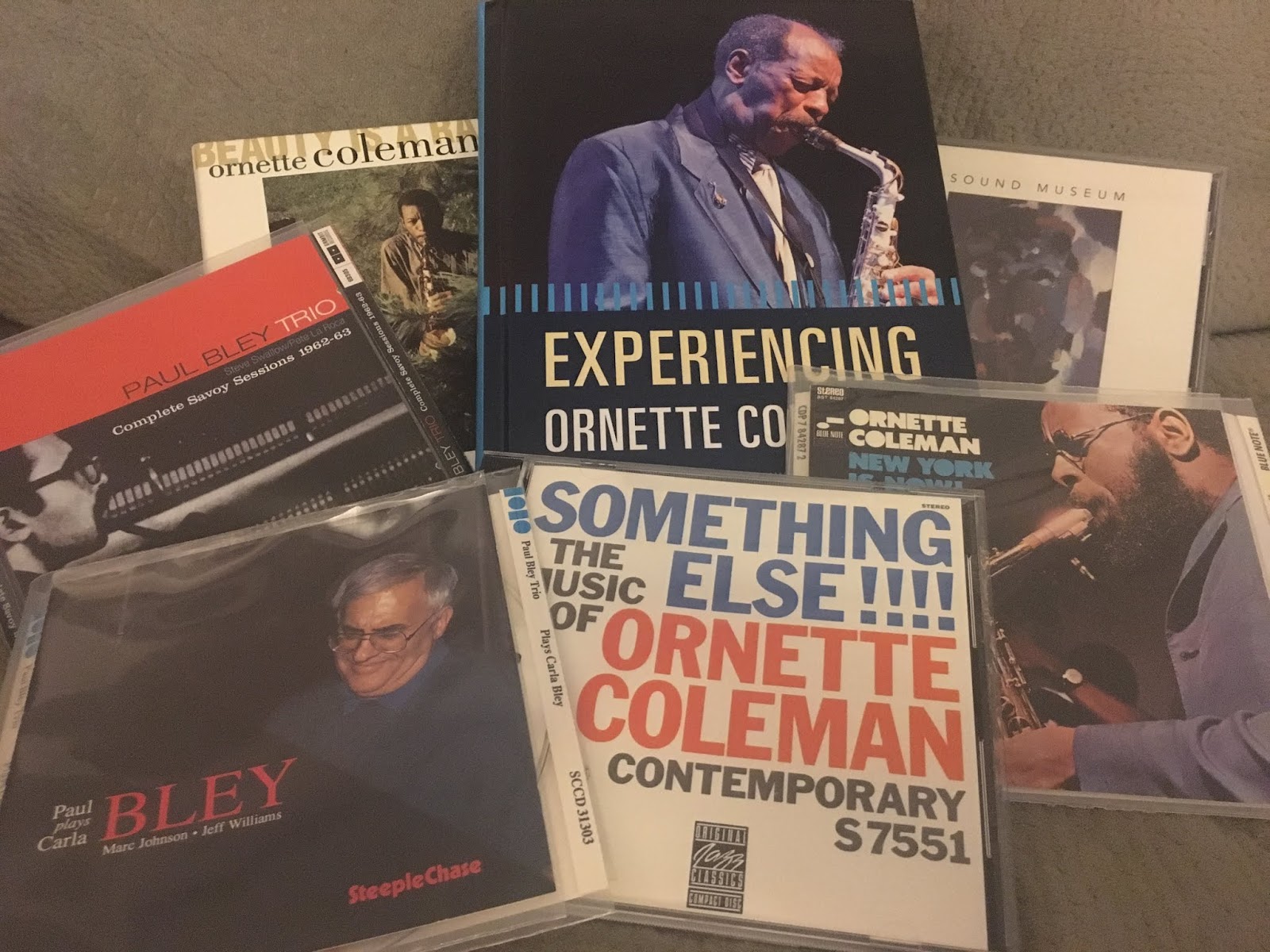
New Zealand Music Month had me listening to a lot of jazz from back home, although towards the end of the month I started listening to selected tracks from a bunch of Ornette Coleman albums. I've been working on the melodies of "Jayne" from Something Else!!!! and "Humpty Dumpty" from This is Our Music. "What Reason" from both of the Sound Museum albums has been getting airtime (both of these albums deserve more of my attention). Ornette on Tenor is the Atlantic album that I have listened to the least, so that has been played a few times over the past week. The hook-up between Jimmy Garrison and Ed Blackwell is superb and it made me want to hear more Garrison with Ornette - coming in the form of New York is Now! (I don't have Love Call...yet). Also tickling my fancy of late has been some Paul Bley - a player never out of rotation for very long. This time round it's been a smattering of tracks from Paul Plays Carla and the Complete Savoy Sessions 1962-63. Not pictured are Song X and Tone Dialing which is where this little blast of Ornette began after I caught myself singing "Kathleen Gray" couple of times and decided to learn it. Accompanying on the train ride to work has been Michael Stephan's Experiencing Ornette Coleman. It's a pretty easy read, not a lot of new information, but it's interesting to read another take on Ornette. I'd be interested in reading Stephen Rush's Free Jazz, Harmolodics and Ornette Coleman. And as it turns out, it's at the public library too, so that will likely be next on the list.
Recorded on this day back in 1960 was Ornette Coleman's Free Jazz. Here is the review that appeared in the January 18, 1962 issue of Down Beat. In order to provide a rounded view, Down Beat published tow reviews - the first by Pete Welding and the second by John Tynan. More vintage magazine articles can be found here.
While listening to the Ornette Coleman memorial broadcast on WKCR 89.9FM NY last week, I was digging through my files looking for some Ornette articles to post. The article below appeared in Time (June 27, 1960). I will be posting the Time features on Duke Ellington, Dave Brubeck and Thelonious Monk - stay tuned. Also, if you missed the memorial broadcast, check out Phil Schaap's archive of shows which includes four Ornette Coleman birthday broadcasts. More vintage magazine articles can be found here.
After posting quite a bit during May, June has been a little quiet on the blog front. Here's a taste of some of the noise bouncing around the apartment for the past month.
Stan Getz: Reflections (Verve) - Somewhere online I read that George Garzone would include this in his "desert island" picks. I hadn't heard it before, so I decided to check it out. It's a strange album with strings, a choir, brass section, standards, a Bob Dylan tune. Although his tone and lyricism aren't lacking at all, it's hard to put aside the corny/syrupy backing - but not my favorite Getz album.
Jimmy Giuffre: Western Suite (Atlantic) - I haven't listened to this album much and made a note to get back to it soon. This time around Jim Hall's comping seems to leap out at me. Jimmy Giuffre 3 (Atlantic) - the first Giuffre album I heard and one that I return to every now and then. This time around it accompanied me on a few occasions while cooking dinner.
Ornette Coleman's passing had me listening to some of his albums that I haven't really checked out before: At the Golden Circle Vol.1 (Blue Note) - I haven't been able to get into this trio as much as the Atlantic quartets (but it's early days still). Skies Of America (Columbia) - Ornette and the London Symphony Orchestra. I heard this not that long after it was reissued, but now I finally have my own copy (courtesy of Reckless Records). The Empty Foxhole (Blue Note) - Another album I've been wanting to check out for some time now. Always good hearing Coleman and Haden together. Isn't it about time there was a decent Ornette on Blue Note box set put together? Of Human Feelings (Antilles) - Of the Prime Time albums I've heard this one struck me a being a little more straight forward/approachable.
ICP Orchestra: East of the Sun (ICP) - The latest from this excellent 10-piece group, and the first (I believe) without Misha Mengelberg at the piano (Guus Janssen has stepped in). I picked this up at their Chicago gig earlier this year. They always keep things varied with freer sections contrasting with written material and abstraction meeting swing. Be sure to give them a listen.
And a few selections from saxophone ensemble recordings including: ROVA:ROVA plays Lacy: Favorite Street (Black Saint) and Figure 8: Pipe Dreams (Black Saint) - On the latter, the quartet is expanded to an octet with the addition of Dave Barrett, Tim Berne, Vinny Golia and Glenn Spearman. I have only recently started listening to ROVA and I've enjoyed what I have heard so far. Julius Hemphill: Fat Man and The Hard Blues (Black Saint) - Hemphill formed his saxophone sextet after he moved on from the WSQ. If you are into the WSQ you'll want to check out this sextet. World SaxophoneQuartet:Rhythm and Blues (Elektra) - After listening to ROVA I was in the mood for more sax quartets and it led me here. After listening to these groups, I have the feeling I'm going to listen to more saxophone ensembles in the near future. Recommendations appreciated.
Randolph Denard Ornette Coleman (March 9, 1930 - June 11, 2015). His music made quite an impact on me in high school after picking up The Shape of Jazz to Come and the then newly released Tone Dialing. Over the last couple of years I have been revisiting Ornette's recordings as well as checking out albums that are new to me. It was a blast hearing him live at the Wellington Festival of the Arts a few years ago, and I will take some time out today to listen to Ornette.
Dan Morgenstern wrote this feature on Ornette shortly after his return to performing following a two-year hiatus. It appeared in the April 8, 1965 issue of Down Beat Magazine. Click on the image to view PDF of full article. More vintage magazine articles (including five on Ornette) can be found here.
On May 22, 1959 Ornette Coleman's quartet recorded the music that would appear on The Shape of Jazz to Come. I was about 17 when first heard the album, and it definitely made an impact on me.John S. Wilson reviewed the album in the December 10, 1959 issue of Down Beat magazine. More vintage magazine articles can be found here.
John Tynan writes with enthusiasm on hearing Ornette Coleman (b. March 9, 1930) for the first time and the mixed reactions Coleman's playing received. It's interesting to note that Tynan was an early advocate of Coleman yet he also famously referred to Coltrane and Dolphy as playing "anti-jazz" - I will post that article sometime soon along with Coltrane & Dolphy's response.
Click the image to view PDF of the full article. More vintage magazine articles can be found here.
Lately I've been working on some of Ornette's melodies - "Peace," "Broadway Blues," "Feet Music" and "Lonely Woman." The most recent has been "The Blessing" and I've enjoyed revisiting his earliest album which I hadn't listened to in a while. Something Else!!!! The Music of Ornette Coleman was compiled from three recording sessions in 1958 (February 10 & 22 and March 24). Here's Art Farmer's review from the July 1959 issue of The Jazz Review. It's great to read one of Coleman's contemporaries thoughts on his work.
This is not a "best of" and it's far from a comprehensive overview of my listening over the past 12 months - just a taste of albums I enjoyed that were new to me during 2014 (I've not focussed on new releases). Aside from the 2014 releases being first, things are in no particular order.
Perhaps I biased, but you'll find Connie's albums on any favourite's list of mine. Recorded in October 2011 (not long after I returned to NZ following a period studying with her) and released in August during Connie's residency at The Stone - another highlight from 2014. I'm always left wondering, "how does she do it?"
Slowfox: The Wood (Jazzwerkstatt) Root 70 with Strings: Riomar (Nwog)
As with Crothers, I'm a big Hayden Chisholm fan. The Wood got plenty of spins this year and I hope this trio record more in the future. There are a few videos of concerts from them floating around YouTube too. I may be a little cheeky including the Root 70 album here as I got it in 2013 but listened to it more in 2014.
Two discs of previously unreleased live recordings, tells you this is essential for anyone interested in Tristano, Konitz and Marsh et al.. The sound quality is pretty descent and the music is excellent. Lets hope for more releases from the Tristano vaults. For whatever reason, this one didn't quite get the same media attention as the Guiffre release.
The Jimmy Giuffre 3 & 4: New York Concerts (Elemental Music)
Another important historical release of previously unissued concert recordings, filling a gap during the post-Free Fall years that went unrecorded. Giuffre (on tenor and clarinet) along with trio (b/d) and quartet (p/b/d), fascinating listening and excellent notes too.
Kazzrie Jaxen Quartet: Callicoon Sessions (New Artists) A Million Shimmering Fish (New Artists)
Kazzire's lush piano shines across both of these quite different releases. The latter features Kazzrie's piano and the poetry of Mark Weber - mostly piano responding to the spoken word (as opposed to the piano accompanying the spoken words). The Quartet has just released a new album which I am yet to hear.
Lester Young: Lady Be Good (unreleased alternate take)
From the collection of George Avakian comes an alternate take from the 1936 "Jones-Smith Inc." session. I hope someone dives in to the collection and discovers more gems such as this. The find of the year?
Paul Bley: Homage To Carla (Owl)
I do enjoy hearing Bley play Bley and this solo disc was on heavy rotation for a while (along with a few other Paul Bley albums). I'll be keeping an eye out for his trio disc on Steeplechase that tackles Carla's songs. In general, I still feel Paul Bley is under appreciated by the jazz community.
Various: West Coast Soundings (EWR)
I got this from Frank Gratkowski after his gig at Constellation (which was excellent). This is two discs of compositions that I guess fall into the the "new music" category. There's a lot of minimalism and drones. My interest was sparked when Frank mentioned there were times during the recording that he felt every note he played was too loud - I think he did pretty well. This was a nice accompaniment as I worked on school stuff.
Steve Lacy: Spirit of Mingus (Freelance) Steve Lacy & Evan Parker: Chirps (FMP)
As usual I listened to my fair share of Lacy this year. It was great hearing the master play a full set of Mingus tunes and how could I resist the Lacy/Parker duo (Parkers debt to Lacy is evident).
Paul Plimley & Lislie Ellis: Kaleidoscopes (HatArt) This was a surprise disc that I picked up purely because this duo (who I was unfamiliar with) was playing the music of Ornette Coleman. I thoroughly enjoyed this album and recommend it to anyone interested in Coleman's music.
Lol Coxhill: Ear of Beholder (Esoteric) Milwaukee 2002 (Emanem) Alone and Together (Emanem)
There has been a steady stream of Coxhill on throughout the year. His personal approach to the soprano has drawn me in - there's a vulnerability and a rambling quality that appeals to be - a very distinctive player. The opening (included here) and closing tracks on Behearer hit my funny bone.
The fidelity of the solo disc is far from ideal but that didn't stop me from enjoying the music. On the duo disc I found that the original compositions written by the producer didn't grab my attention the way the standard tunes (solo & duo) did.
Ornette Coleman: In All Languages (Harmolodic/Verve)
Around the middle of the year I revisited some album's of Ornette's I hadn't listened to for some time. Along the way I picked up this one which I hadn't heard. The disc splits Prime Time and a reunion of the original quartet and it's worthwhile checking out the two groups takes on the same songs.
Art Tatum: Exactly Like You
This comes from a mid-1940s live recording (sorry but I've misplaced the full info!). Lewis Porter played this to us in class early last year. Check out striking chorus of single note lines.
John Surman: Fragments (ECM) Thimar (ECM) A Biography Of The Rev. Absalom Dawe (ECM) Stranger Than Fiction (EMC)
I haven't listened to much John Surman over the years. For me, he's a player that has slipped through the cracks so this year I made bit of an effort to listen to some of his work. I focused on his soprano work but he is strong on baritone sax and bass clarinet too. It was enough for me to want some more.
I went to the Jazz Record Mart on New Year's eve hoping to find Jay Clayton's Sound Songs. They didn't have it and I was in the mood for some vocals so on a whim I picked this up - a nice mellow way to take out 2014.
Monday:
It was a late practice session today and the mind and body were quite tired but it turned out to be a good session. Modus Vetus - 1 phrase in cycle ascending and descending in whole tones from the starting point (E, F#, D, G#, C, A# and Eb, F, Db, G, B, A). It's nice breaking up the order in which you practice things.
Overtones - lots of tone matching and some overtone scales.
Balkan song - just a couple of spots that keep slipping my mind.
Improvising - emphasis on tonal/pitch variation and dynamics. The music itself seemed to move between quite tonal and more abstract.
Wednesday:
When I came to type up my notes I discovered I hadn't written any for today. From memory I worked on the following.
Overtones. Modus Vetus and Modus Novas - 1 phrase in a cycle that follows the same shape as the Monday session (but from a different starting note).
"Broadway Blues" - alone and with the recording.
Thursday: Modus Vetus - 1 phrase in a cycle that follows the same shape as the Monday session (but from a different starting note).
Balkan Tune - about 2 or 3 minutes into working on this a spring broke (right hand D). In about 20 years of playing sax that's only the second spring to break on me (the other was when I was at music school I think).
Overtones - something you can practice without worrying about springs not working!
Was going to finish up after that but then realised that the rubber band the keeps my reed case shut was staring me in the face. I hooked it up and continued.
Started working on Ornette Coleman's "Feet Music" from both versions on In All Languages (which I picked up at Reckless Records along with New York Is Now!). The album splits his original quartet with Prime Time (playing some of the same tunes).
Even though the spring broke I still felt that the session was pretty good.
Sunday: Modus Vetus - 1 phrase in all keys this time in an expanding semi-tone cycle (F, F#, E, G, Eb, G#, D, A, Db, A#, C, B)
Overtones - warmed up with Letting It Fall before moving on to the Rascher book (the last line of page 15 and the first two lines of page 16). Modus Novas - 1 phrase in 6 keys - this one took me a while to get in to so I will finish it off during my next practice.
"Feet Music" - although I hadn't played for a couple of days I did my best to keep the sound of this melody in my mind. It's coming together - I played it solo and along with the recording(s).
Rhythm - I started off the session today working on playing a bell rhythm in my left hand with a shifting pulse beneath (6, 4, 3 and 2). In between each of the above I continued working on it (just for a couple of minutes).
The passing of Charlie Haden back in July led me to listening to plenty of his work with Ornette Coleman. Starting with some albums I am quite familiar with (The Shape of Jazz To Come, Change of The Century and This Is Our Music and the duo record Soapsuds, Soapsuds)and moving on to one I hadn't heard before (In All Languages). That led me to some albums of Haden playing Ornette Tunes sans Coleman - two volumes of The Montreal Tapes. Thefirst with Paul Bley and Paul Motian and other with Don Cherry and Ed Blackwell, which in turn led me to a few other albums featuring the work of Coleman.
Paul Plimley and Lisle Ellis Kaleidoscopes (Hat Art)
I was unfamiliar with both Plimley (piano) and Ellis (bass) but my keenness to hear various takes on the music of Ornette Coleman led to grab this album. According to the liner notes, they started working as a duo since 1980. By the time Kaleidoscopes was recorded (1992) the had developed a great rapport. Ellis' tone is rich and woody (the bass sounds unamplified), complementing Plimley's light touch. Both musicians can swiftly fly around their instruments but I never felt it was "chops for chops sake."
I wasn't surprised that seven of the 11 tunes come from the quartet recordings on Atlantic, but I was pleased they included some less common tunes. Yes, "Chronology," "Peace" and "Beauty Is A Rare Thing" are present but so too are "Street Woman," "Long Time No See" and "Moon Inhabitants."
I believe this album is out-of-print (my copy came from Academy Records on 18th St. during a recent trip to NYC), it's been getting a fair fair bit of airplay in the apartment and I encourage fans of Coleman's music to hunt it out.
Paul Bley - Notes On Ornette (Steeplechase) 1997
Paul Bley is one of my favourite pianists and listening to the album above made me give this trio disc (with Jay Anderson (b) Jeff Hirshfield (d)) a spin too. Comparing the two, Bley's is probably more approachable for those coming from a "straight ahead" background - it's more conventional with the rhythm section walking and Bley blowing on top. Okay, so that description sells the album short, but I'm speaking in very general terms - there's a lot more to it that.
Whereas solo works by Bley tend to be somewhat reflective (at least from what I've heard so far), when playing with a rhythm section there's an energy and rhythmic push that Bley puts into his notes that differs from the solo works.
Bley contributes one original (which fits the flow of the album) with the rest of the material coming from Coleman. Five tunes from his albums on Contemporary Records and one ("Crossroads") that was captured live at the Hillcrest Club in 1958 (with Bley on piano) and may have appeared later on Atlantic (I'm writing from memory). It seems to make sense that Bley would choose material from the period in which he was playing with Coleman. As a long standing champion of Coleman's music it is a shame that there are no studio recordings of the two together.
Here are a few pages from the January 7, 1960 issue of Down Beat Magazine. First up, Ornette Coleman is the subject of Leonard Feather's "Blindfold Test." He comments on the likes of George Russell, Charles Mingus, Quincy Jones, Miles Davis and Yusef Lateef. Then his quartet (with Don Cherry, Charlie Haden and Billy Higgins) is "Caught In The Act" at the Five Spot Cafe by George Hoefer. Enjoy.
Haden @ Jazz Middelheim August 2009 photo by Guy Van de Poel
The web is alive with tributes to Charlie Haden and I
felt it was necessary to add my two cents. I spent some time on Friday
afternoon listening to some selections from the post-Ornette quartet "Old and
New Dreams" and Etudes (trio with Geri Allen & Paul Motian), Memoirs (trio
Paul Bley & Paul Motian). He has plenty of room to shine on Soapsuds,
Soapsuds, a duo with Ornette Coleman.
Improvisers (on any instrument) can learn so much from his melodicism and economy. The later being a rare quality (we all tend to over-play) and is something I am becoming increasing interested in. The man could say a lot with a little and his music came from a deep place. One of my favourites.
I first heard Haden during my mid-late teens on
Ornette Coleman’s The Shape Of Jazz To Come. At the time my ears were drawn to Ornette's playing and it wasn't until years later that I started coming to grips with the importance of Haden in this music. It’s an album that I’ll write
about separately at a later date.
He was brought to my attention again a couple of years later
on Lee Konitz’ Alone Together (Blue Note). This album got some serious airplay
in 1999-2001. I was transcribing Lee’s solo on “What Is This Thing Called
Love?” and my saxophone teacher challenged me, saying something along the lines
of, “Why? What are you going to learn from that?” – I didn’t know what to say!
Haden’s backing of Konitz (and Brad Mehldau) is superb – not a wasted note on
the entire album. The same can be said for his solos to. I heard a Konitz/Haden
duo set was recorded but I have never managed to track it down (I found a pic
of the album cover somewhere online years ago). If anybody out there can direct
me to it I’d be extremely grateful.
I only heard Haden in person once – a duo with Paul
Bley at the Blue Note in NYC in 2009. I could only afford to sit at the bar,
where they crammed us in like sardines. It was a pretty disappointing listening
experience and put me off going to the Blue Note again (it was my first time
there). I spent the evening squeezed in the corner unable to see the bandstand
and having to put plenty of chatter around me. However, I had no complaints
about the music. Here are links to just a few of the many tributes: Nate Chinen at the New York Times, the Free Jazz Collective Blog, NPR Remembering Charlie Haden.
Miles Davis: "Live in Tokyo" (CBS)
This disc led me to listening to a bunch of Sam Rivers last week.
Sam Rivers:
"Vista" (Meta) A nice trio of Adam Rudolph (percussion), Harris Eisensadt (drums) and Rivers on Tenor/Soprano sax/Flute/. He didn't slow down in his later years - recorded in 2003 just before his 80th birthday.
"Crystals" (Impulse). I was familiar with the 2 big band discs from the 1990's on RCA but this one was new to me. A very distinctive big band writer.
"Waves" (Tomato)
"Hues" (Impulse)
"Streams" (Impulse)
Sam Rivers output from the 70's has managed to evade my ears until I had bit of a binge this week. Feel-wheeling, powerful blowing with plenty of continuity.
Cecil Taylor:
"Jazz Advance" (Transition) A bold debut with the added bonus of some early Steve Lacy.
"Nefertiti, The Beautiful One Has Come" (Revenant Records) A live recording of an early incarnation of the Cecil Taylor Unit.
"Unit Structures" & "Conquistador" (Blue Note) Two classics on Blue Note (I tend to favor the latter). I enjoy the contrasts in this group - the bass playing of Silva & Grimes....Taylor's density & Lyons roots in Bird.
"For Olim" (Soul Note) Recommended if you are wondering where to start with Taylor's solo work.
There has been plenty of Ornette Coleman related albums on too. Ornette Coleman:
"Something Else!" (Contemporary) I hadn't listened to this one in ages. I remember one of my friends being into this album (Hi Brad!) and playing 'The Blessing' back in our days at what is now the NZSM.
"The Shape of Jazz to Come" (Atlantic)
"Live at the Golden Circle Vol.1" (Blue Note)
"Free Jazz" (Atlantic) Other disc I hadn't listened to in quite some time. Enjoyed much more this time round.
Old & New Dreams: "Old & New Dreams" (Black Saint) For those of you that enjoy Ornette Coleman's work on Atlantic this group (of Coleman Alumni) makes an excellent follow up.
Keith Jarrett: "Fort Yawh" (Impulse) Jarrett's 'American Quartet' - a group I haven't listened to that much.
Don Cherry: "Complete Communion" (Blue Note) A nice place to start with Cherry's work after the Coleman Quartet. Two, four movement suites with nice playing all round - particularly the rhythm section of Ed Blackwell & Henry Grimes.
John Coltrane & Don Cherry: "The Avant-Garde" (Atlantic) I feel this album is pretty up & down and can see why it wasn't initially released by Atlantic - must have sounded quite tame compared to what Coltrane was playing when it was released in 1966 ( the year "Ascension" & "Meditations" were released). Coltrane's earliest studio date on soprano.
 I first heard Virgin Beauty at the Wellington Public Library. Right around the same time I got Tone Dialing shortly after it was released, but I think Virgin Beauty was my introduction to Prime Time. I was well aware of Ornette at the time, but Prime Time was a different beast.